Introduction
Have you received a text message containing “STTM” and wondered what it means? This abbreviation can be confusing if you have never encountered it in a conversation, social media comment, or direct message.
STTM most commonly means “Stop Talking To Me” in texting and internet slang. People use it to tell someone to stop talking, stop messaging, or end a particular conversation. Depending on the situation, it can express genuine frustration or playful annoyance between friends.
What Does STTM Mean?+1
For example, a friend might text “STTM 😂” after you tease them about something embarrassing. In another conversation, “STTM. I need space” may communicate a serious boundary.
In this guide, you will learn what STTM stands for, how people use it in text messages, what it means on social media, how to recognize its tone, and how to respond naturally.
What Does STTM Mean in Text?
STTM stands for “Stop Talking To Me.” It is an informal abbreviation used in digital conversations when someone wants another person to stop talking or communicating with them.
The phrase can be direct and serious, but its emotional meaning depends on the context.
Here are three examples:
- Serious: “STTM. I don’t want to argue anymore.”
- Playful: “STTM 😂 you’re making me laugh so hard.”
- Frustrated: “Bro, STTM. I’ve explained this already.”
In the first example, the sender wants to end a discussion. The second, the sender may be joking with a friend. In the third, the abbreviation expresses irritation.
The key is to read the entire conversation rather than interpreting the four letters in isolation.
Quick definition of STTM
| Detail | Explanation |
| Full form | Stop Talking To Me |
| Category | Texting abbreviation / initialism |
| Main purpose | Asking someone to stop talking or messaging |
| Tone | Serious, annoyed, playful, or sarcastic |
| Common settings | Text messages, chats, comments, and DMs |
| Formality | Informal |
What Does STTM Stand For?
STTM is formed from the first letters of the phrase “Stop Talking To Me.”
- S = Stop
- T = Talking
- T = To
- M = Me
Instead of typing the complete sentence, someone can use the four-letter abbreviation to communicate the same basic message quickly.
STTM is an initialism because its letters are generally read individually rather than pronounced as a single word.
It belongs to the broader category of internet shorthand, which includes expressions such as LOL, BRB, and IDK. However, STTM can sound more confrontational than many everyday abbreviations because its underlying phrase directly addresses another person’s behavior.
How Is STTM Used in Text Messages?
People may use STTM in different situations, depending on their relationship with the recipient and the conversation’s tone.
1. When Someone Wants to End a Conversation
The most straightforward use of STTM is to end a discussion that the sender no longer wants to continue.
Example:
Alex: Why are we still Arguing About This?
Jordan: STTM. I’m done discussing it.
Here, Jordan is clearly expressing a desire to stop the conversation.
2. When Someone Feels Annoyed
STTM can communicate frustration when someone keeps repeating a question, making unwanted comments, or bringing up an uncomfortable subject.
Example:
A: I told everyone about your embarrassing moment.
B: Seriously, STTM.
In this exchange, the abbreviation expresses annoyance rather than friendly humor.
3. When Friends Are Joking
Close friends sometimes use STTM as exaggerated dramatic language after a funny remark or playful tease.
Example:
Mia: You practiced that dance for three hours and still missed the beat. 😂
Emma: STTM 😭
Emma may be laughing rather than genuinely asking Mia to stop talking.
Nevertheless, emojis alone do not guarantee that a message is a joke. Consider the relationship and surrounding conversation.
4. When Someone Needs Personal Space
STTM may communicate that a person needs privacy, quiet, or time away from a conversation.
Example:
A: Can we please talk about what happened?
B: STTM for now. I need some time alone.
The sender is asking for space. A respectful response is to stop messaging and let them decide when they are ready to communicate again.
Is STTM Serious or Playful?
STTM can be either serious or playful. The phrase itself remains the same, but the sender’s intention changes according to the situation.
| Clue | Possible interpretation |
| A laughing emoji after a funny joke | Possibly playful |
| A conversation full of teasing between close friends | Possibly humorous |
| A disagreement or heated argument | More likely serious |
| “Please stop messaging me” alongside STTM | A clear request for space |
| Repeated requests to stop contacting someone | A boundary that must be respected |
| A short reply after unwanted comments | Possibly frustration |
These clues are not absolute rules. The best interpretation comes from the full conversation and what the sender communicates directly.
Important: If someone clearly asks you to stop contacting them, do not assume they are joking just because they have used slang or an emoji.
STTM Meaning on Snapchat, TikTok, Instagram, and WhatsApp
STTM can appear on different social platforms, but the underlying phrase generally remains “Stop Talking To Me” when used as texting slang. The platform alone does not determine the meaning.
What Does STTM Mean?+1
STTM on Snapchat
On Snapchat, STTM may appear in private chats or conversations between friends.
For example:
“You keep sending embarrassing snaps. STTM 😂”
This could be playful teasing. If the sender instead says they do not want further messages, take that request seriously.
STTM on TikTok
STTM may appear in TikTok comments, Direct Messages, or discussions about videos.
For example:
“STTM, you’re making me laugh at work.”
The comment may express exaggerated amusement. During an argument, however, the same abbreviation can be a direct way to end an exchange.
Dexerto
STTM on Instagram
On Instagram, the abbreviation may be used in DMs, comments, or conversations between friends.
Example:
“You exposed my old pictures. STTM 😭”
The sender might be embarrassed and joking, although the context is essential to understanding the message.
STTM on WhatsApp
In WhatsApp chats, STTM may communicate annoyance, a desire to end a conversation, or playful frustration.
Example:
“STTM for a while. I need to concentrate on my work.”
This message suggests that the sender wants a break from the conversation.
These platform examples illustrate possible uses; they do not establish that STTM is equally popular on every app.
Other Possible Meanings of STTM
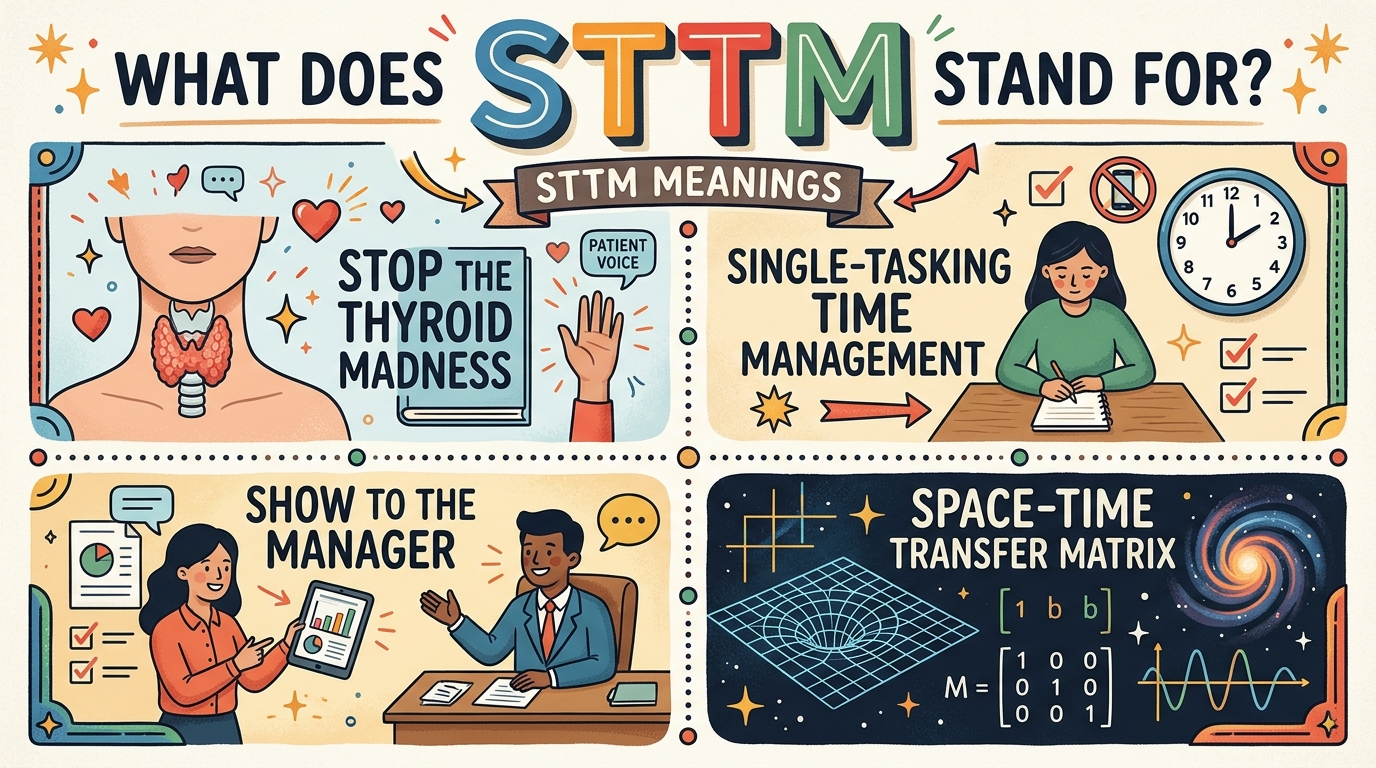
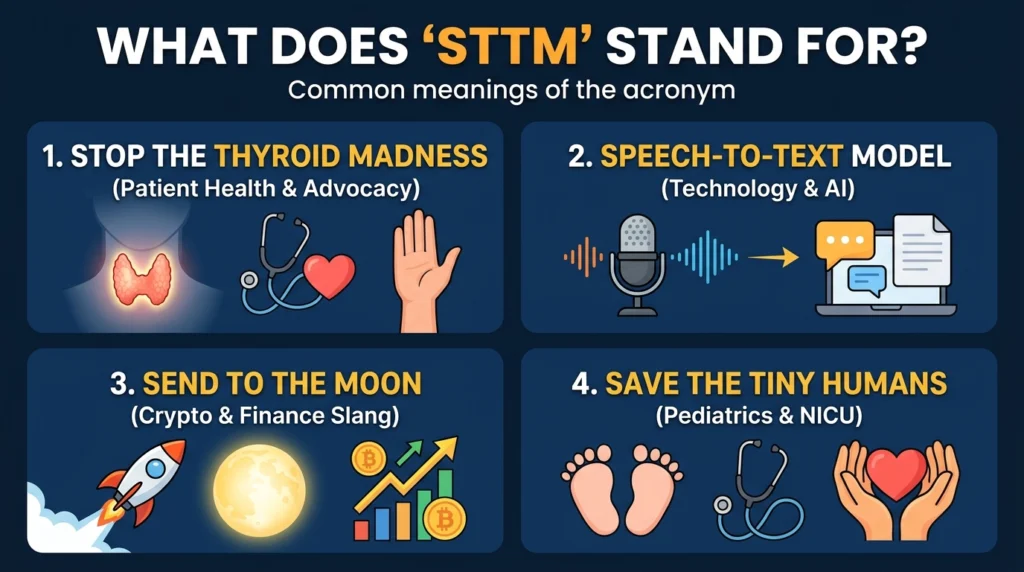
Although “Stop Talking To Me” is the best-supported interpretation in everyday texting, the same four letters can have other meanings in particular contexts.
| Possible expansion | Context | How to interpret it |
| Stop Talking To Me | Texting and social media | A request to stop talking or communicating |
| Send This To Me | Possible informal usage | A request to share a photo, link, or other content |
| Spill The Tea To Me | Possible informal usage | A request to share gossip or details |
| Source-to-Target Mapping | Data engineering | A technical document mapping source data fields to target fields |
The alternative texting expansions are not as firmly established as “Stop Talking To Me.” Do not assume that “Send This To Me” or “Spill The Tea To Me” is the intended meaning without supporting context. Source-to-target mapping, by contrast, is a recognized technical use of the same initials.
Meaning Insider+1
How to identify the intended meaning
Look at the message surrounding STTM.
- If someone is arguing or asking for distance, “Stop Talking To Me” is the strongest interpretation.
- If the message concerns a photo or link, the sender may be requesting that content, but clarification may be necessary.
- If the conversation is about gossip, consider whether the sender is asking you to share details.
- If the discussion involves databases, ETL pipelines, or data integration, the technical meaning may apply.
When the context does not provide enough information, asking what the sender means is better than guessing.
How to Reply When Someone Sends STTM
Your response should depend on whether the message appears serious, playful, or ambiguous.
If They Are Serious
When someone genuinely wants the conversation to stop, acknowledge their request without arguing.
Possible replies:
- “Okay, I’ll give you some space.”
- “Understood. I won’t push the conversation.”
- “I’m sorry if I upset you.”
- “I’ll respect your wishes.”
You do not need to send all these messages. One brief, respectful response is usually enough, and you should stop contacting them if they have asked you to do so.
If They Are Joking
If you know the person well and the context clearly suggests playful teasing, you can respond with lighthearted humor.
Possible replies:
- “Okay, okay 😂”
- “Fine, I’ll behave.”
- “You started it 😭”
- “I’m just telling the truth!”
Avoid assuming that every short or emoji-filled message is playful, especially if the conversation has become tense.
If You Are Unsure What They Mean
When the intention is unclear, use a neutral response rather than escalating the situation.
Possible replies:
- “Do you mean that Seriously?”
- “Okay, do you want some space?”
- “I don’t want to misunderstand you.”
- “Would you prefer to talk about this later?”
If the sender confirms that they want you to stop messaging them, respect that boundary.
STTM vs. Similar Texting Abbreviations
STTM can look similar in purpose to other abbreviations used to pause, end, or disengage from conversations. However, these expressions do not all communicate the same intention.
| Abbreviation | Full form | Main difference |
| STTM | Stop Talking To Me | Directly asks someone to stop talking |
| TTYL | Talk To You Later | Suggests talking again later |
| GTG | Got To Go | Indicates that the sender needs to leave |
| BRB | Be Right Back | Usually signals a temporary absence |
| IDC | I Don’t Care | Expresses indifference |
| STFU | Shut The F*** Up | A much harsher, profane expression |
The most important difference is that STTM can communicate a boundary, while TTYL and BRB usually indicate a temporary pause. STFU is substantially more offensive because it includes profanity.
Understanding these distinctions helps you interpret messages accurately and avoid unnecessary misunderstandings.
Common Mistakes When Understanding STTM
A few common assumptions can lead to incorrect interpretations.
Assuming It Always Means Anger
Although STTM can be confrontational, friends may use it playfully. Consider the conversation before deciding how the sender feels.
Treating Every Alternative Expansion as Established Slang
Not every phrase invented to match an acronym is a widely recognized meaning. “Stop Talking To Me” has stronger support in texting references than several alternative expansions.
Assuming Every Platform Uses It Differently
There is no reliable basis for assigning a completely different definition to STTM on every social platform. The surrounding message is generally more useful than the app itself.
Ignoring a Clear Boundary
If someone explicitly asks you to stop talking or messaging them, do not dismiss the request as a joke. Respecting that boundary is more important than decoding the slang perfectly.
People Also Ask
STTM most commonly means “Stop Talking To Me.” It is used when someone wants another person to stop talking, messaging, or continuing a discussion.
It can sound rude or dismissive because it directly tells someone to stop talking. However, friends may also use it jokingly. Tone and context determine how it comes across.
A guy using STTM may be expressing frustration, asking for space, or joking with someone he knows well. The abbreviation alone does not establish his feelings or intentions.
A girl using STTM generally communicates the same basic message: “Stop Talking To Me.” Depending on the conversation, it could be serious, playful, or sarcastic.
On TikTok, STTM commonly stands for “Stop Talking To Me.” It may appear in comments or messages as a serious request to end a conversation or as playful banter.
Conclusion
STTM most commonly means “Stop Talking To Me” in text messages and online conversations. It can communicate frustration, a desire to end a discussion, or playful annoyance between friends.
To understand what someone means, consider the conversation, the relationship, and the tone of the message. Remember that alternative expansions exist, but they should not be treated as equally established without evidence.
If someone uses STTM to express a genuine boundary, respect their request. If the meaning is unclear, ask politely instead of making assumptions. This simple approach will help you understand STTM and respond appropriately in everyday digital conversations.