Introduction
If someone sends you “NTY” in a text message, you might wonder whether they are being polite, rejecting an offer, or showing a lack of interest. The good news is that this abbreviation has a straightforward meaning in most everyday conversations.
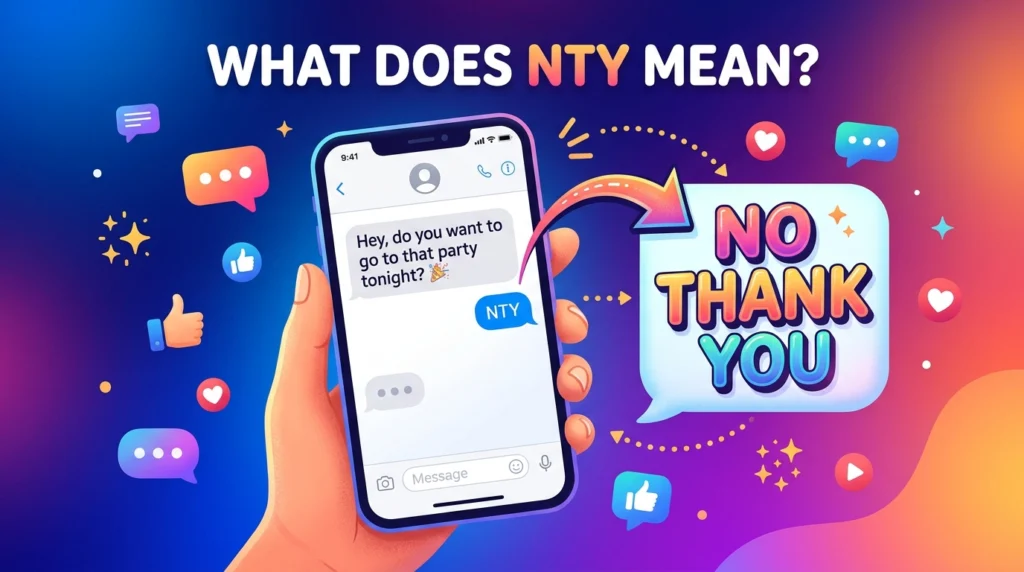
NTY means “No, Thank You.” It is a common texting abbreviation used to decline an offer, invitation, suggestion, or request without typing the entire phrase.
For example:
- Friend: Do you want to grab some coffee?
- You: NTY, I already had some.
In this conversation, NTY politely communicates that you do not want the coffee.
You may encounter NTY in text messages, Snapchat chats, Instagram DMs, WhatsApp conversations, TikTok comments, gaming chats, and online marketplaces. Although its basic meaning usually stays the same, its tone can vary depending on the situation and the relationship between the people communicating.
In this guide, you will discover the full meaning of NTY, how people use it on social media, what it means when a guy or girl sends it, and how to respond naturally.
What Does NTY Mean in Text Messages?
NTY stands for No, Thank You. It is an informal abbreviation that allows someone to refuse something quickly while acknowledging the offer.
People commonly use it when they do not want to accept an invitation, purchase an item, join an activity, or participate in a suggested plan.
Here is a quick breakdown:
| Term | Meaning |
| NTY | No, Thank You |
| Full phrase | No, thank you. |
| Type | Texting abbreviation and internet slang |
| Main purpose | Declining an offer or suggestion |
| Typical tone | Polite, casual, or firm |
| Common platforms | Text messages, Snapchat, Instagram, WhatsApp, and online chats |
NTY is generally more courteous than a plain “No” because it includes an expression of thanks. However, a short response without any additional context can sometimes sound abrupt.
For instance, “NTY, but thanks for asking!” sounds warmer than simply sending “NTY.”
The key is to understand the conversation rather than assuming that every short reply has a hidden meaning.
NTY Meaning on Snapchat
On Snapchat, NTY usually means “No, Thank You.” People use it in direct messages when declining a suggestion, invitation, request, or offer.
Snapchat conversations often involve short, casual replies, making abbreviations convenient.
Example 1: Declining a Snap streak
- Friend: Wanna start a streak?
- You: NTY, I don’t use Snapchat that much.
2: Refusing an invitation
- Friend: Wanna hang out tonight?
- You: NTY, I’m staying home today.
3: Turning down a request
- Friend: Can I borrow your account?
- You: NTY, sorry!
In these examples, NTY communicates a refusal. It does not automatically mean the sender is angry or upset with you.
If someone sends NTY without an explanation, respect their answer instead of assuming they dislike you.
NTY Meaning on Instagram
On Instagram, NTY generally means “No, Thank You.” It may appear in direct messages, comment replies, or conversations about collaborations, promotions, invitations, and recommendations.
For example:
Conversation 1:
- Person A: Want to collaborate on my next Reel?
- Person B: NTY, but thanks for asking!
The second person is politely declining the collaboration.
Conversation 2:
- Person A: You should buy this outfit.
- Person B: NTY, it’s not my style.
Here, NTY indicates that the person is not interested in the suggested outfit.
Conversation 3:
- Person A: Follow my other page, please!
- Person B: NTY, I’m good.
The response declines the request without providing a lengthy explanation.
On Instagram, the meaning remains the same as in regular texting. The surrounding messages help you determine whether the response is friendly, neutral, or dismissive.
NTY Meaning on WhatsApp
NTY on WhatsApp also stands for “No, Thank You.” People use it in private chats, family groups, friend groups, and everyday conversations.
Because WhatsApp supports both casual and professional communication, the appropriateness of NTY depends on whom you are messaging.
Example:
- Friend: Do you need a ride home?
- You: NTY, my brother is picking me up.
Another example:
- Family member: Would you like some more Food?
- You: NTY, I’m full.
In both situations, NTY communicates a simple refusal.
When messaging a colleague, customer, or someone you do not know well, writing “No, thank you” in full may sound more professional and considerate.
NTY Meaning on TikTok
On TikTok, NTY usually means “No, Thank You.” Users may use it in comments, direct messages, or discussions when rejecting a suggestion, trend, invitation, or promotional offer.
For example:
- Comment: You should try this challenge!
- Reply: NTY 😂
Or:
- Creator: Want to promote your account on my page?
- Reply: NTY, but I appreciate the offer.
Depending on the conversation, NTY may sound playful, casual, or firm. An emoji can make a refusal feel lighter, but it does not necessarily change the abbreviation’s meaning.
NTY Meaning in Gaming and Online Chats
Gamers and members of online communities often use abbreviations to communicate quickly. NTY can be useful when declining a team invitation, item trade, game request, or offer from another player.
Example 1: Declining a trade
- Player A: Trade your rare skin for mine?
- Player B: NTY.
2: Refusing to join a team
- Player A: Join our squad?
- Player B: NTY, I’m playing solo.
3: Rejecting an offer
- Player A: Want some free items?
- Player B: NTY, I’m good.
In these situations, NTY is usually a practical way to decline without interrupting the conversation.
It can also appear in online marketplaces when someone does not want to accept a seller’s price, a buyer’s offer, or a proposed deal.
What Does NTY Mean From a Girl?
When a girl sends NTY, it usually means “No, Thank You.” She may be declining an invitation, refusing an offer, or expressing that she is not interested in a particular suggestion.
The meaning depends on what you asked her and how the conversation was going.
1. She Is Politely Declining an Offer
You: Want me to get you something to drink?
Her: NTY, I’m fine.
She is simply saying that she does not want a drink.
2. She Is Declining an Invitation
You: Want to go to the movies this weekend?
Her: NTY, I have other plans.
She is turning down the invitation. Her message does not necessarily reveal anything beyond that decision.
3. She May Not Be Interested in a Romantic Invitation
You: Would you like to go on a date with me?
Her: NTY, but thank you.
In this context, she is declining your invitation. It is best to respect her response rather than pressure her for another answer.
4. She Wants to Keep the Conversation Short
You: Should I send you the link?
Her: NTY.
She may simply prefer not to receive the link.
Important: NTY does not have a special meaning when a girl uses it. Consider the actual conversation, respect her boundaries, and avoid interpreting three letters as proof of her feelings.
What Does NTY Mean From a Guy?
When a guy texts NTY, it generally means “No, Thank You.” He may be declining an invitation, refusing an offer, or indicating that he does not want something.
For example:
Example 1:
- You: Want to play football this evening?
- Him: NTY, I’m tired.
He is declining because he does not feel like playing.
Example 2:
- You: Do you want me to help you?
- Him: NTY, I’ve got it.
He is saying that he does not need help.
Example 3:
- You: Want to meet up This Weekend?
- Him: NTY, I’m busy.
He is turning down the suggestion and providing a reason.
If NTY appears in a romantic conversation, it may communicate a refusal or lack of interest in the specific invitation. However, you cannot determine someone’s entire attitude toward you from the abbreviation alone.
Is NTY Rude or Polite?
NTY is generally a polite or neutral way to decline something because it stands for “No, Thank You.” Nevertheless, its tone can change depending on the situation, punctuation, and relationship between the people involved.
Consider these examples:
| Message | Possible tone | Why |
| NTY, but thanks! | Friendly | Shows appreciation |
| NTY 😊 | Warm or casual | The emoji can soften the refusal |
| NTY, I’m good. | Neutral | Gives a straightforward answer |
| NTY. | Brief or firm | Offers little additional context |
| Hard NTY 😂 | Playful or emphatic | Strongly rejects the suggestion, possibly jokingly |
| No, thank you. | Polite or formal | Uses the complete phrase |
These are possible interpretations, not fixed rules. Even a message ending with a period is not automatically rude.
How to Tell Whether NTY Sounds Dismissive
Look at three things:
1. The previous message: If you offered something the other person did not need, NTY may be entirely ordinary.
2. The additional wording: A response such as “NTY, I appreciate it” is more explicitly appreciative than a bare abbreviation.
3. The relationship and communication style: Some people regularly use short replies, while others normally explain their decisions.
The most reliable interpretation comes from the full conversation, not capitalization or punctuation alone.
How to Reply When Someone Texts NTY
The best response to NTY is usually simple, friendly, and respectful. You do not need to convince the person to change their mind or demand an Explanation.
Here are some natural replies for different situations.
| Situation | Suggested reply |
| A friend declines your offer | No worries! |
| Someone refuses an invitation | That’s okay, maybe another time. |
| Someone declines politely | Of course, no problem! |
| Someone rejects a suggestion | Fair enough! |
| A person declines a purchase | Thanks for letting me know. |
| Someone refuses help | All good, just let me know if you need anything. |
| A person declines a date | No problem. Thanks for being honest. |
| Someone gives a playful refusal | Haha, fair enough 😂 |
Casual Replies
Use these when chatting with friends:
- No worries!
- All good.
- Fair enough.
- That’s cool.
- No problem 😊
- Maybe next time!
Polite Replies
Use these when you want to sound considerate:
- Of course, I understand.
- That’s completely fine.
- Thanks for letting me know.
- No problem at all.
- I appreciate you telling me.
Replies in Romantic Conversations
If someone declines a date or romantic invitation, respond calmly and respect their decision.
Examples:
- No worries, thanks for being honest.
- That’s okay. I respect that.
- No problem. Take care!
Avoid repeatedly asking the person to reconsider. A clear refusal should be respected.
NTY vs. TY vs. NTYL vs. NVM
NTY can be confused with other short texting abbreviations, especially when people are unfamiliar with internet slang.
Here is how these expressions differ.
| Abbreviation | Full form | Meaning |
| NTY | No, Thank You | Politely declines something |
| TY | Thank You | Expresses gratitude |
| TYSM | Thank You So Much | Expresses greater appreciation |
| NTYL | Not a widely standardized abbreviation | Meaning may depend on context; do not assume it means NTY |
| NVM | Never Mind | Tells someone to disregard or forget something |
| NT | No Thanks | Declines an offer |
| NP | No Problem | Indicates that something is okay |
NTY and TY are particularly easy to confuse, but their Meanings are different. NTY declines an offer, whereas TY expresses gratitude.
For example:
- NTY: Want some tea? — NTY, I’m fine.
- TY: Here’s your tea. — TY!
Similarly, NVM is not interchangeable with NTY. Saying “NVM” usually means the person is withdrawing a request or telling someone to disregard something, while NTY means they are declining an offer.
NTY Examples in Everyday Conversations
The following examples show how NTY can fit naturally into different types of messages.
Example 1: Food
Friend: Want a slice of pizza?
You: NTY, I’m full.
Example 2: Shopping
Friend: Should we buy these shoes?
You: NTY, they’re too expensive for me.
Example 3: Social Plans
Friend: Are you coming to the party tonight?
You: NTY, I need some rest.
Example 4: Online Shopping
Seller: Would you like to purchase this item?
Buyer: NTY, I’m just browsing.
Example 5: Gaming
Player A: Want to trade your item?
Player B: NTY, I’m keeping it.
Example 6: School or College
Classmate: Want to join our study group?
You: NTY, I’m studying with my friends.
Example 7: Work
Colleague: Would you like me to take over this task?
You: NTY, but I appreciate the offer.
For a professional conversation, the complete phrase may be preferable to the abbreviation.
Example 8: Dating
Person A: Would you like to go out with me?
Person B: NTY, but I appreciate you asking.
Example 9: Social Media
Friend: Want to try this viral trend?
You: NTY 😂
Example 10: Helping Someone
Friend: Do you need a hand with that?
You: NTY, I’ve got it. Thanks!
Across these examples, NTY consistently communicates a refusal. The additional words explain the reason or make the response sound more considerate.
When Should You Use NTY?
NTY is most suitable for informal situations where both people understand texting abbreviations.
Use it when:
- A friend offers you food, a drink, or help.
- Someone invites you to an informal event.
- You want to decline a suggestion in a group chat.
- You are responding to a casual social media message.
- You want to reject an online trade or purchase offer.
- You are chatting in a gaming community.
However, writing the full phrase “No, thank you” is usually better in formal emails, business negotiations, customer service conversations, and sensitive personal discussions.
For example, instead of replying “NTY” to a professional invitation, you could write:
“Thank you for the invitation. Unfortunately, I won’t be able to attend.”
This response communicates the same basic refusal in a more professional manner.
Common Misunderstandings About NTY
Although NTY is simple, people can sometimes misinterpret it.
Misunderstanding 1: NTY Means Thank You
Incorrect. TY means “Thank You,” while NTY means “No, Thank You.” The word “no” changes the meaning.
Misunderstanding 2: NTY Always Means Someone Is Angry
Incorrect. A person may simply be declining an offer. Anger cannot be reliably inferred from the abbreviation alone.
Misunderstanding 3: NTY Is Always Rude
Incorrect. NTY is commonly used as a polite or neutral refusal. However, it may sound abrupt in a serious conversation when no additional context is provided.
Misunderstanding 4: NTY Has a Different Meaning From a Girl or Guy
Not usually. The standard meaning is “No, Thank You,” regardless of who sends it.
Misunderstanding 5: NTY Means Someone Dislikes You
Not necessarily. Someone can decline an invitation or offer without disliking the person who made it.
Understanding these distinctions can help you avoid unnecessary confusion in digital conversations.
People Also Ask
NTY means “No, Thank You.” It is a common abbreviation used to decline an offer, invitation, suggestion, or request in text messages and online conversations.
On Snapchat, NTY usually means “No, Thank You.” It is commonly used to decline an invitation, Snap streak request, suggestion, or other offer.
NTY on Instagram generally stands for “No, Thank You.” People may use it in DMs or comments when refusing an invitation, collaboration, promotion, or suggestion.
NTY is a refusal, so it means the person is declining the specific offer. It is not automatically positive or negative emotionally; the tone depends on the context.
When a girl sends NTY, she is usually saying “No, Thank You.” She may be declining an offer, invitation, or suggestion. The abbreviation alone does not reveal her broader feelings toward you.
Conclusion
The meaning of NTY in text is simple: NTY stands for “No, Thank You.” It is a widely recognized texting abbreviation that people use to decline offers, invitations, suggestions, and requests in everyday digital conversations.
You may encounter NTY on Snapchat, Instagram, WhatsApp, TikTok, gaming platforms, and in regular text messages. Although it usually communicates a straightforward refusal, its tone can range from friendly and polite to brief and firm.
If someone sends you NTY, consider the context before interpreting the message. A short refusal does not automatically mean that the person is angry or dislikes you. And when you use NTY yourself, adding a brief explanation or a friendly expression can make your response sound more considerate.
Ultimately, understanding NTY helps you communicate more clearly, interpret short messages accurately, and respond naturally in everyday online conversations.