Introduction
Have you ever received a text that says “ONG, I’m telling the truth” or seen someone comment “ONG that was crazy” on TikTok? If you are wondering what it means, you are not alone. Internet slang can be confusing when a few letters carry an entire message.
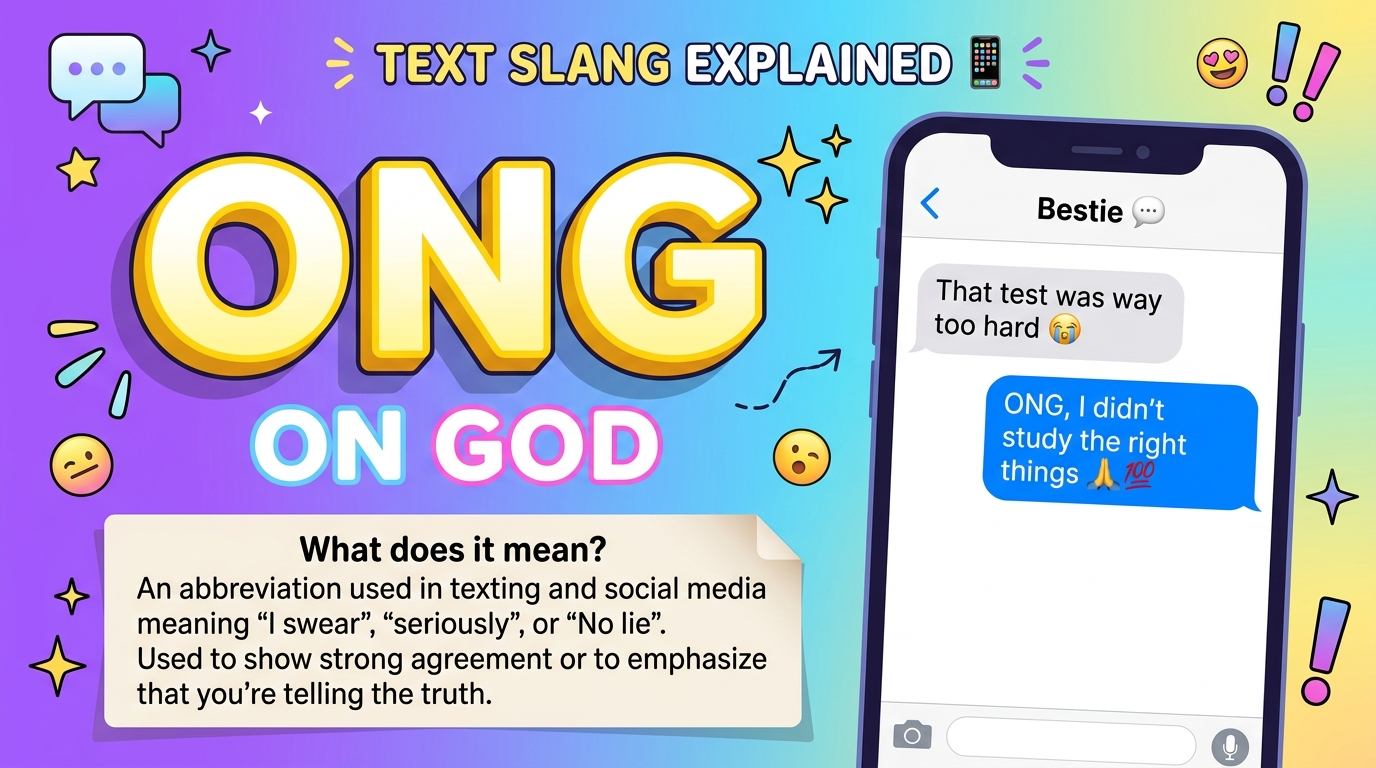
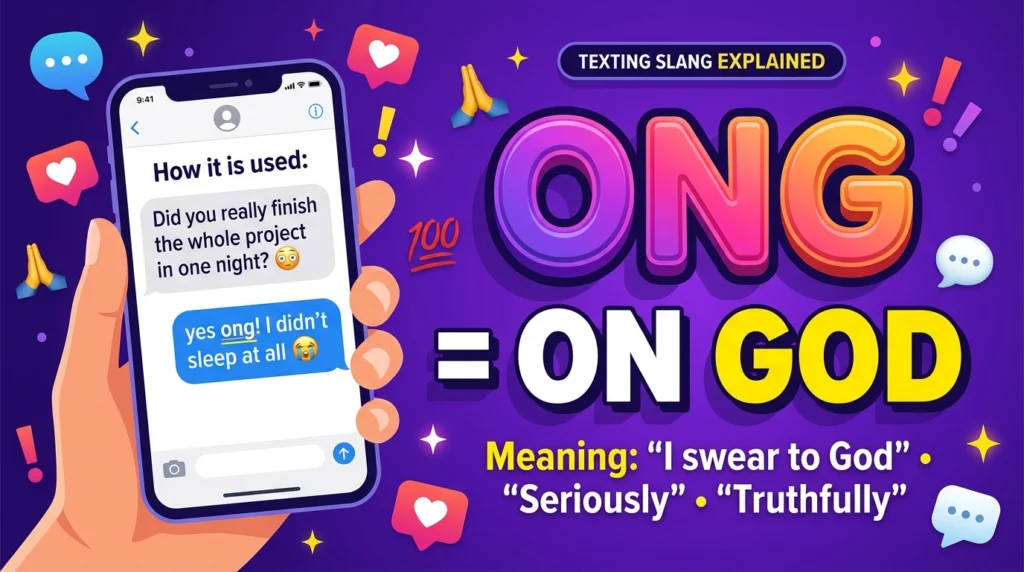
ONG means “On God” in texting and internet slang. People use it to emphasize that they are telling the truth, being serious, or strongly agreeing with someone. Depending on the conversation, it can mean “I swear,” “I’m being honest,” or “for real.”
For example, if a friend texts, “ONG, I didn’t take your charger,” they are emphasizing that they are telling the truth.
ONG is commonly seen in casual text messages, Snapchat conversations, TikTok comments, Instagram DMs, and group chats. In this guide, you will learn what ONG stands for, how to interpret it in different situations, how it compares with similar slang, and how to reply naturally.
What Does ONG Mean in Text?
ONG stands for “On God.” It is an informal expression used to emphasize honesty, sincerity, certainty, or strong feelings.
When someone writes ONG, they usually want to make their statement sound more convincing or emphasize how strongly they believe something.
Here are the most common interpretations:
| Meaning | How to understand it | Example |
| I swear | Emphasizing that something is true | “ONG, I saw him yesterday.” |
| I’m serious | Showing sincerity | “ONG, I’m not joking.” |
| For real | Emphasizing a genuine opinion | “That song is amazing ONG.” |
| I agree | Strongly agreeing with someone | “ONG, that exam was difficult.” |
| I can’t believe it | Expressing surprise or emotion | “ONG, you actually won!” |
The exact meaning depends on the message and the conversation. In most casual online settings, ONG functions as an emphasis marker rather than a literal religious statement.
What Does ONG Stand For?
ONG stands for “On God.” The expression comes from the idea of invoking God to emphasize that a statement is truthful or sincere.
In everyday digital communication, people often use it as a shorter way to express strong conviction.
For example:
- “ONG, I’m telling the truth.” means “I swear I’m telling the truth.”
- “This is the best pizza ever, ONG.” emphasizes a strong opinion.
- “ONG, you need to watch that movie.” expresses an enthusiastic recommendation.
The abbreviation is informal and is generally used in writing rather than formal speech. Dictionary.com describes ONG as an abbreviation of “on God” associated with honesty, strong belief, and intense emotion.
It is worth remembering that the phrase references God, so some people may prefer not to use it for personal or religious reasons.
How Is ONG Used in Text Messages?
ONG can communicate different feelings depending on where it appears in a sentence. Understanding the context is the easiest way to interpret it correctly.
1. To Emphasize Honesty
One of the most common uses of ONG is to reassure someone that you are telling the truth.
Example:
Alex: Did you borrow my headphones?
Sam: ONG, I didn’t touch them.
Here, Sam uses ONG to emphasize that the statement is truthful.
2. To Show Strong Agreement
People also use ONG when they completely agree with someone’s opinion or experience.
Example:
Mia: That homework was way too difficult.
Lily: ONG, I Spent Three Hours On It.
Lily is essentially saying, “I completely agree with you.”
3. To Express Excitement
ONG can add excitement to a message about good news, an achievement, or an unexpected event.
Example:
Noah: I just got tickets to the concert!
Ryan: ONG, you’re so lucky!
The abbreviation intensifies Ryan’s enthusiastic reaction.
4. To Emphasize an Opinion
Someone may place ONG at the beginning or end of a sentence to show how strongly they feel about something.
Example:
“ONG, this is my favorite show.”
The person is emphasizing their genuine enthusiasm for the show.
5. To React to Something Surprising
ONG can also express disbelief or surprise when someone shares unexpected information.
Example:
Ella: I met my favorite actor yesterday.
Sophie: ONG, are you serious?
Sophie is expressing surprise and asking whether the news is true.
ONG Meaning on Snapchat, TikTok, Instagram, and WhatsApp
ONG generally retains the same meaning across social media platforms: “On God.” However, the context in which someone uses it can change its tone.
ONG Meaning on Snapchat
On Snapchat, ONG often appears in private chats, group conversations, and replies to stories. Friends might use it to emphasize a claim, agree with a message, or react to something surprising.
Example: “ONG, your story was hilarious.”
Meaning: The person genuinely found your story funny.
ONG Meaning on TikTok
On TikTok, ONG is commonly used in comments and informal exchanges to emphasize opinions, agree with another user, or react strongly to a video.
Example: “ONG, this trend is everywhere.”
Meaning: The commenter strongly emphasizes that the trend is widespread.
ONG Meaning on Instagram
On Instagram, you may encounter ONG in direct messages, Reel comments, and conversations between friends.
Example: “ONG, your outfit looks amazing.”
Meaning: The sender is strongly emphasizing Their Compliment.
ONG Meaning on WhatsApp
On WhatsApp, ONG can appear in one-to-one chats and group messages. The surrounding conversation usually determines its meaning.
Example: “ONG, I sent you the file already.”
Meaning: The sender is emphasizing that they have already sent the file.
ONG Meaning in Gaming Chats
In gaming conversations, ONG can emphasize a reaction to a match, a player’s performance, or an unexpected result.
Example: “ONG, that was the luckiest win ever.”
Meaning: The player is strongly emphasizing their reaction to the win.
The key point is that the platform rarely changes the core definition. The surrounding message tells you whether ONG expresses honesty, agreement, excitement, or surprise.
ONG Meaning From a Guy or Girl
People sometimes wonder whether ONG has a different meaning when a guy or girl sends it. Usually, it does not. The abbreviation still means “On God.”
What changes is the intention behind the message.
When a Guy Says ONG
A guy might use ONG to:
- Emphasize that he is telling the truth.
- Agree with something you said.
- Express excitement about a shared interest.
- Make a casual conversation sound more emphatic.
- Emphasize a compliment.
Example:
You: Do you actually like this song?
Him: ONG, it’s my favorite.
He is emphasizing that he genuinely likes the song.
When a Girl Says ONG
A girl might use ONG to:
- Show that she genuinely agrees.
- Emphasize a personal opinion.
- React to exciting or surprising news.
- Reinforce a statement.
- Express enthusiasm in a friendly conversation.
Example:
You: I think we should go shopping this weekend.
Her: ONG, I’ve been waiting for this!
She is enthusiastically agreeing with The Suggestion.
Does ONG Mean Someone Likes You?
Not necessarily. ONG alone is not a reliable sign of romantic interest.
If someone says, “ONG, you look amazing,” they may be complimenting you sincerely. However, the message could be friendly, playful, or flirtatious depending on your relationship and the wider conversation.
Look at the full conversation rather than interpreting one abbreviation as proof of someone’s feelings.
ONG vs. OMG, FR, ISTG, and No Cap
It is similar to several other internet slang expressions, but each has a slightly different emphasis.
| Slang | Full form | Main meaning |
| ONG | On God | Emphasizing honesty or strong conviction |
| OMG | Oh My God | Expressing surprise, excitement, or shock |
| FR | For Real | Showing agreement or sincerity |
| ISTG | I Swear to God | Strongly emphasizing a statement or expressing frustration |
| No cap | No lie; not exaggerating | Emphasizing honesty or authenticity |
| TBH | To Be Honest | Introducing an honest opinion |
| IKR | I Know, Right? | Expressing agreement or shared understanding |
ONG vs. OMG
ONG and OMG look similar, but they mean different things.
- ONG: “On God.” Used to emphasize honesty, sincerity, or strong agreement.
- OMG: “Oh My God.” Used to express surprise, excitement, shock, or disbelief.
Example:
“ONG, I finished the project.” emphasizes that the speaker is telling the truth.
“OMG, I finished the project!” expresses excitement or surprise about completing it.
ONG vs. FR
FR means “For Real.” Both expressions can communicate sincerity or agreement.
Example:
Person A: This movie is incredible.
Person B: FR!
If Person B says “ONG, this movie is incredible,” they are emphasizing the strength of their opinion.
ONG vs. ISTG
ISTG stands for “I Swear to God.” It is often used to emphasize sincerity, frustration, or a strong promise.
ONG and ISTG overlap in meaning, but ISTG can sound more intense or frustrated depending on the situation.
Example:
“ONG, I didn’t do it.” emphasizes that the speaker is telling the truth.
“ISTG, I didn’t do it.” can sound like a stronger insistence, particularly during an argument.
ONG vs. No Cap
“No cap” means no lie or no exaggeration. It is often used to emphasize that an opinion or statement is genuine.
Example:
“ONG, this is the best burger I’ve ever had.”
“No cap, this is the best burger I’ve ever had.”
Both sentences emphasize the speaker’s opinion, although the expressions have different origins and nuances.
How to Reply When Someone Says ONG
Your reply depends on what the person means. You do not need to use slang yourself to respond naturally.
| Situation | Example message | Possible reply |
| They emphasize honesty | “ONG, I’m telling the truth.” | “Okay, I believe you.” |
| They agree with you | “ONG, that test was hard.” | “Right? It was so difficult.” |
| They compliment you | “ONG, you look great.” | “Thank you! That’s so sweet.” |
| They express excitement | “ONG, we got tickets!” | “No way! That’s amazing!” |
| They share surprising news | “ONG, I met her yesterday.” | “Seriously? Tell me everything!” |
| They emphasize an opinion | “ONG, this song is perfect.” | “I know, it’s so good.” |
| They use it during an argument | “ONG, I didn’t say that.” | “Let’s go back to what actually happened.” |
Casual Replies to ONG
If you are Chatting With Friends, short responses can keep the conversation flowing:
- “FR!”
- “I know, right?”
- “For real?”
- “Exactly!”
- “No way!”
- “That’s crazy.”
- “I believe you.”
- “Tell me more.”
Choose a response that fits the message rather than automatically replying with another abbreviation.
Is ONG Rude or Offensive?
ONG is not inherently rude. It is usually informal slang used among friends, classmates, and people who communicate casually online.
However, its tone depends on the situation.
Friendly use: “ONG, that was hilarious.” This is an enthusiastic reaction.
Serious use: “ONG, I didn’t do anything.” This emphasizes honesty.
Argumentative use: “ONG, stop accusing me.” This can sound frustrated or defensive.
The phrase also references God, which may be sensitive for some people. If you are unsure whether someone is comfortable with religious expressions, a neutral alternative such as “Honestly,” “For real,” or “I’m serious” may be more appropriate.
Avoid using ONG in formal emails, professional reports, academic writing, or other settings where standard language is expected.
When Should You Use ONG?
ONG works best in informal conversations where the other person understands internet slang.
Use it when you want to:
- Emphasize that you are being truthful.
- Strongly agree with a friend’s opinion.
- Express excitement about news or an event.
- Make an enthusiastic reaction more emphatic.
- Communicate casually in a group chat or social media comment.
Avoid using it when writing a formal message, communicating with someone unfamiliar with slang, or discussing a serious matter where clarity and professionalism are important.
Common Mistakes to Avoid
Confusing ONG with OMG: They are different expressions. ONG means “On God,” while OMG means “Oh My God.”
Assuming ONG always means agreement: It can also emphasize honesty, sincerity, or emotion.
Treating it as proof of romantic interest: The abbreviation alone does not reveal whether someone is flirting.
Using it in every sentence: Repeating slang excessively can make messages sound unnatural.
Assuming the person is making a religious statement: In many online conversations, ONG functions as an informal expression of emphasis, although individual intentions can vary.
People Also Ask
ONG means “On God.” It is an informal slang expression used to emphasize honesty, sincerity, strong belief, or agreement. It can be similar to saying “I swear” or “for real.”
The full form of ONG in texting slang is “On God.” The abbreviation is commonly used in online conversations and social media messages.
On Snapchat, ONG usually means “On God.” People use it in chats and story replies to emphasize a statement, agree with a friend, or react strongly to something.
On TikTok, ONG means “On God.” It often appears in comments to emphasize an opinion, show agreement, or express a strong reaction to a video.
No. ONG stands for “On God,” while OMG stands for “Oh My God.” ONG usually emphasizes sincerity or conviction, whereas OMG commonly expresses surprise, excitement, or shock.
Conclusion
The meaning of ONG in text is simple: ONG stands for “On God.” People use it to emphasize honesty, sincerity, strong agreement, or an intense reaction.
You may encounter it in Snapchat chats, TikTok comments, Instagram DMs, WhatsApp messages, and other casual online conversations. Although it can sometimes resemble OMG in appearance, the two expressions Have Different Meanings.
When someone sends you ONG, pay attention to the rest of their message to understand whether they are expressing honesty, agreement, excitement, or frustration. Once you recognize the context, interpreting this common texting abbreviation becomes much easier.