Introduction
Have you ever seen “TW” at the beginning of a text message, TikTok video, Instagram caption, or Reddit post and wondered what it means? This abbreviation is common in online conversations, but its meaning can depend on the context.
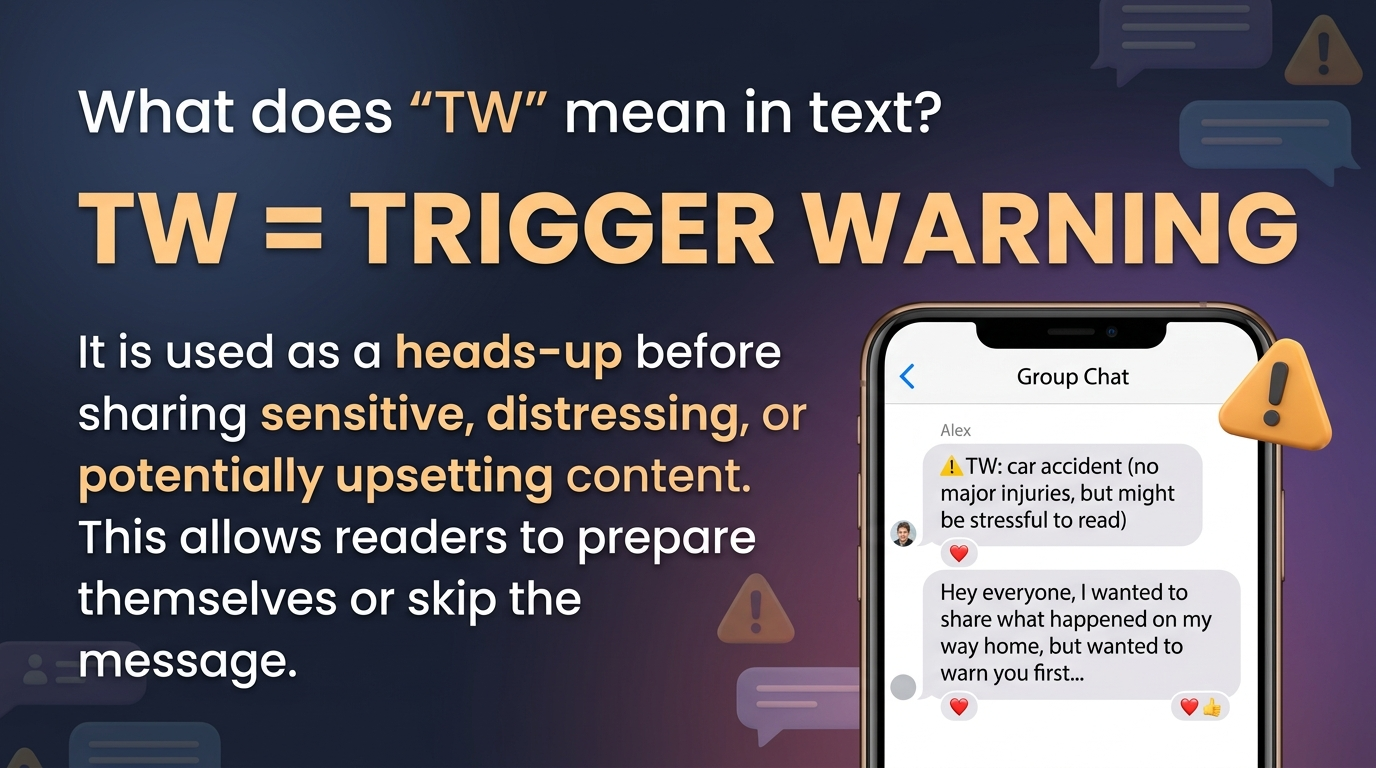
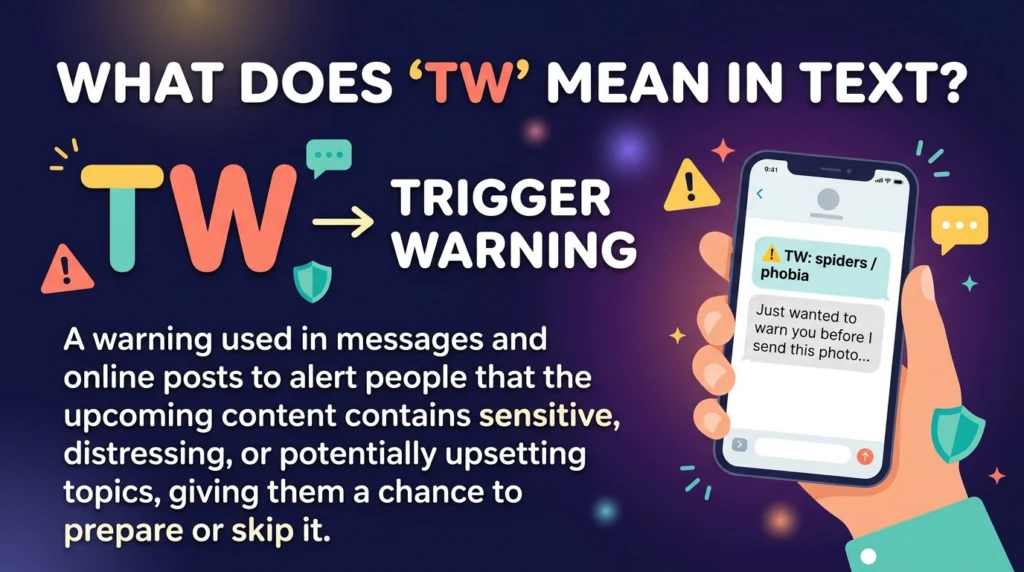
The most common TW meaning in text is “Trigger Warning.” People use it to alert readers that a message, post, image, or video contains potentially upsetting or sensitive material. For example, “TW: discussion of grief” tells readers what subject the following content will cover.
However, TW can also have other meanings in different situations, including “this week” or abbreviations related to a particular subject. Understanding the words around it helps you interpret the message correctly.
In this guide, you will learn what TW means in texting, how people use it on social media, practical examples, the difference between TW and CW, and how to respond when someone sends it to you.
What Does TW Mean in Text?
TW usually stands for Trigger Warning in texting and internet slang. It is a short notice placed before potentially distressing content to help readers decide whether they want to continue.
For example:
“TW: This post discusses a difficult family experience.”
The sender is giving readers advance notice about the subject. They are not necessarily asking a question or expressing an emotion; they are preparing the audience for what comes next.
You may encounter TW in:
- Private text messages and group chats.
- Instagram captions, Stories, and comments.
- TikTok videos and descriptions.
- Reddit discussions and online forums.
- Discord communities and sensitive-topic conversations.
- Blogs, articles, and personal stories.
In simple words: TW means “Trigger Warning” when it appears before potentially upsetting content.
What Does TW Stand for in Different Contexts?
Although “Trigger Warning” is the primary meaning in sensitive online conversations, TW is not limited to one definition.
| Context | Possible meaning | Example |
| Text messages | Trigger Warning | “TW: difficult news” |
| TikTok | Trigger Warning | “TW: scary imagery” |
| Trigger Warning | “TW: discussion of grief” | |
| Workplace messages | This Week | “TW priorities are ready.” |
| Geographic discussions | Taiwan | “TW travel information” |
| Technical or specialized settings | Depends on the field | Check the relevant terminology |
Dictionary.com recognizes TW as an abbreviation for “trigger warning” and also lists Taiwan in a different usage.
The phrase “this week” is a possible informal shorthand, not a universal definition. Always interpret the abbreviation in light of the surrounding sentence.
10 TW Meaning in Text Examples
The easiest way to understand TW is to see how people use it in actual conversations. The following are illustrative examples of common online usage.
| Example message | Meaning |
| “TW: violence in this story.” | The story discusses violence. |
| “TW: I’m talking about grief today.” | The post covers a sensitive subject. |
| “TW: blood in the next clip.” | The video may contain blood. |
| “TW: difficult family experiences.” | The post discusses a potentially upsetting experience. |
| “TW: panic attacks.” | The content discusses panic attacks. |
| “TW: animal injury.” | The post mentions or depicts an injured animal. |
| “TW: disturbing scenes ahead.” | The following content may be distressing. |
| “TW: discussion of abuse.” | The content addresses abuse. |
| “TW: flashing lights.” | The content may contain flashing imagery. |
| “TW: spoilers for the finale.” | The post reveals important plot details. |
Notice that not every warning concerns trauma. People may also use TW informally to flag spoilers or other material they think readers would prefer to know about beforehand.
A good warning identifies the relevant topic rather than simply saying that something unpleasant is coming.
What Does TW Mean on Social Media?
TW has the same general meaning across most social platforms: it alerts people to potentially sensitive material. However, the way it appears can vary by platform and community.
TW Meaning on TikTok
On TikTok, TW may appear in a video caption, on-screen text, a description, or a creator’s introductory message. It alerts viewers that the video may discuss or show sensitive material.
Example:
“TW: discussion of grief. Sharing my experience in case it helps someone.”
The warning helps viewers make an informed choice before watching. A written warning should be clear and visible before the relevant content whenever possible.
TW Meaning on Instagram
On Instagram, users may place TW at the beginning of a caption, Story, Reel description, or post discussing a difficult experience.
Example:
“TW: mental health struggles. This is a personal reflection on a difficult period in my life.”
A clear warning is particularly helpful when the post includes sensitive personal experiences. If the topic is specific, naming it is generally more informative than using TW alone.
TW Meaning on Snapchat
On Snapchat, TW may appear in a private message, group conversation, or Story. Someone might use it before discussing an upsetting experience or sharing a sensitive image.
Example:
“TW: accident details. Are you okay with me telling you what happened?”
Here, the sender is providing context and giving the recipient a chance to decide whether to continue the conversation.
TW Meaning on WhatsApp
On WhatsApp, TW can be used in one-to-one messages or group chats before sharing difficult news or discussing a sensitive subject.
Example:
“TW: family loss. I want to share something personal with everyone.”
Because WhatsApp conversations are often private, a short warning can also serve as a considerate way to approach a difficult topic.
TW Meaning on Reddit and Discord
On Reddit and Discord, TW may be placed before a discussion, post, message, or community resource that covers sensitive material. Some communities also use content labels or formatting rules.
Example:
“TW: abuse discussion. Please read the topic note Before Opening the thread.”
Follow the rules of the particular community. A text warning may not hide an image or automatically prevent someone from seeing sensitive material.
Is TW the Same as CW?
TW and CW are closely related, but they are not exactly interchangeable in every community.
- TW means Trigger Warning and is often used when material could be distressing, particularly for people with related traumatic experiences.
- CW means Content Warning and is a broader label for potentially upsetting, disturbing, offensive, or otherwise sensitive material.
Cambridge Dictionary distinguishes the two terms while describing both as notices placed before material that some people may find upsetting.
| Feature | TW | CW |
| Full form | Trigger Warning | Content Warning |
| Main purpose | Flag potentially triggering content | Flag potentially sensitive content |
| Common subjects | Trauma, abuse, violence, grief | Spoilers, graphic material, difficult topics |
| Typical format | “TW: violence” | “CW: spoilers” |
| Meaning in everyday use | Often specific to emotional distress | Often broader in scope |
These are general tendencies, not strict rules. Some people and online communities use the terms interchangeably.
Should You Use TW or CW?
Choose the label that best describes the content and fits the expectations of your audience. For discussions of trauma or potentially distressing experiences, TW may be appropriate. For a broader warning about spoilers, graphic imagery, or other sensitive material, CW may be clearer.
The most important part is the descriptive label after The Abbreviation. “CW: spoilers” tells readers more than “CW” by itself.
How to Reply When Someone Sends You TW
If someone sends you a message beginning with TW, you usually do not need to respond to the abbreviation itself. Read the topic label and decide whether you are comfortable continuing.
Here are some natural responses for different situations.
| Situation | Example reply |
| You are comfortable continuing | “Thanks for the heads-up. Go ahead.” |
| You appreciate the warning | “I appreciate you letting me know.” |
| You need more information | “What topic does the warning refer to?” |
| You would rather not read it | “Thanks for warning me. I’ll skip this one.” |
| You want to support a friend | “I’m here for you if you want to talk.” |
| You are unsure about the content | “Could you give me a little context first?” |
| You need to set a boundary | “I can’t discuss that topic right now, but thank you for understanding.” |
Your reply should match the situation. A serious conversation deserves a considerate response, while a simple spoiler warning may only require a quick acknowledgment.
What If Someone Uses TW Before Sharing Something Personal?
A warning can indicate that the person is trying to approach a difficult subject thoughtfully. It does not automatically mean they are in crisis or asking you to solve a problem.
You can acknowledge the warning, ask whether they feel comfortable sharing, and respect their boundaries as well as your own.
Why Do People Use TW?
People use TW to provide context before sharing material that may be difficult for others to read or watch. The purpose is to make online communication more considerate by giving people information before they encounter the content.
Common reasons include:
- Providing advance notice: Readers know what topic is coming.
- Respecting personal boundaries: People can choose whether to continue.
- Discussing difficult experiences: Writers can share personal stories with context.
- Building awareness: Creators can discuss sensitive subjects without surprising their audience.
- Improving communication: A short label clarifies the nature of the content.
A trigger warning is a courtesy, not a guarantee that someone will avoid distress. Its usefulness depends on how clearly and appropriately the warning describes what follows.
How to Use TW Correctly
If you want to use TW in a text message or social media post, follow these simple guidelines.
1. Put the Warning Before the Content
Place the warning where readers can see it before encountering the material it describes.
Example:
TW: discussion of a serious accident. Here is what happened.
2. Name the Topic Clearly
Avoid vague warnings when a More Specific Description is possible.
- Vague: “TW: sensitive stuff.”
- Clearer: “TW: discussion of grief.”
Specific labels help people make informed choices.
3. Keep the Warning Relevant
Use TW when the content could reasonably be upsetting or connected to a sensitive experience. Do not add it automatically to every ordinary conversation.
4. Respect the Reader’s Choice
Avoid pressuring people to read, watch, or discuss something after they have indicated they would rather not.
5. Follow Community Guidelines
Some online communities have specific rules about warning labels, spoiler formatting, or graphic content. Follow those rules when posting.
What Are the Other Meanings of TW?
Outside everyday social media use, TW can refer to different terms. Some are established technical or geographic abbreviations, while others depend on a particular community.
| Alternative meaning | Context |
| Taiwan | Geographic and internet-domain contexts |
| This Week | Informal workplace shorthand, when clearly established |
| Total Weight | Certain jewelry and gemstone listings |
| Terawatt | Energy and scientific measurements |
| Older informal references to the platform now known as X |
The geographic abbreviation for Taiwan and the use of TW for trigger warning are documented by Dictionary.com. Other specialized meanings should be verified against the relevant field or source.
These alternatives should not be treated as equally common in texting. If you see “TW: violence” before a post, Trigger Warning is the natural interpretation. If you see “1.00 TW” in a jewelry listing, the context points toward total weight instead.
TW vs. NSFW vs. Spoiler Alert
These labels can appear in similar online spaces, but they communicate different information.
| Abbreviation or label | Full meaning | Purpose |
| TW | Trigger Warning | Flags potentially distressing content |
| CW | Content Warning | Flags potentially sensitive content more broadly |
| NSFW | Not Safe for Work | Flags material that may be unsuitable for a workplace or public setting |
| Spoiler Alert | Spoiler alert | Warns that important story details may be revealed |
For example, “TW: grief” identifies a potentially distressing topic. “NSFW” indicates that content may be inappropriate in a professional or public environment, while “Spoiler alert” signals that a story’s plot may be revealed.
These labels are not substitutes for one another. Choose the one that best describes the material.
People Also Ask
TW usually means Trigger Warning. It alerts the recipient that the following message may discuss something sensitive or upsetting.
On Instagram, TW generally means Trigger Warning. It may appear before a caption, Story, Reel description, or post about a sensitive topic.
On TikTok, TW is commonly used before content that may be distressing or sensitive. It can appear in captions, descriptions, or on-screen text.
If a girl writes TW before a message, she most likely means Trigger Warning when the conversation involves sensitive material. The abbreviation alone does not indicate romantic interest, anger, or a particular emotion.
If a guy uses TW before a post or message, it usually serves the same purpose: to warn readers about potentially upsetting content. The surrounding message determines the intended meaning.
Conclusion
The most common TW meaning in text is Trigger Warning. It is a short notice used before potentially sensitive or upsetting content, allowing readers to decide whether they want to continue.
You may encounter TW on TikTok, Instagram, Snapchat, WhatsApp, Reddit, Discord, and in private messages. Remember that CW means Content Warning, and although the two labels are closely related, they are not always used in precisely the same way.
If you see TW before a message, look at the topic that follows it. If you want to use TW yourself, make the warning specific, place it before the relevant content, and respect your audience’s choice.
That simple understanding will help you interpret TW correctly and use it thoughtfully in Online Conversations.