Introduction
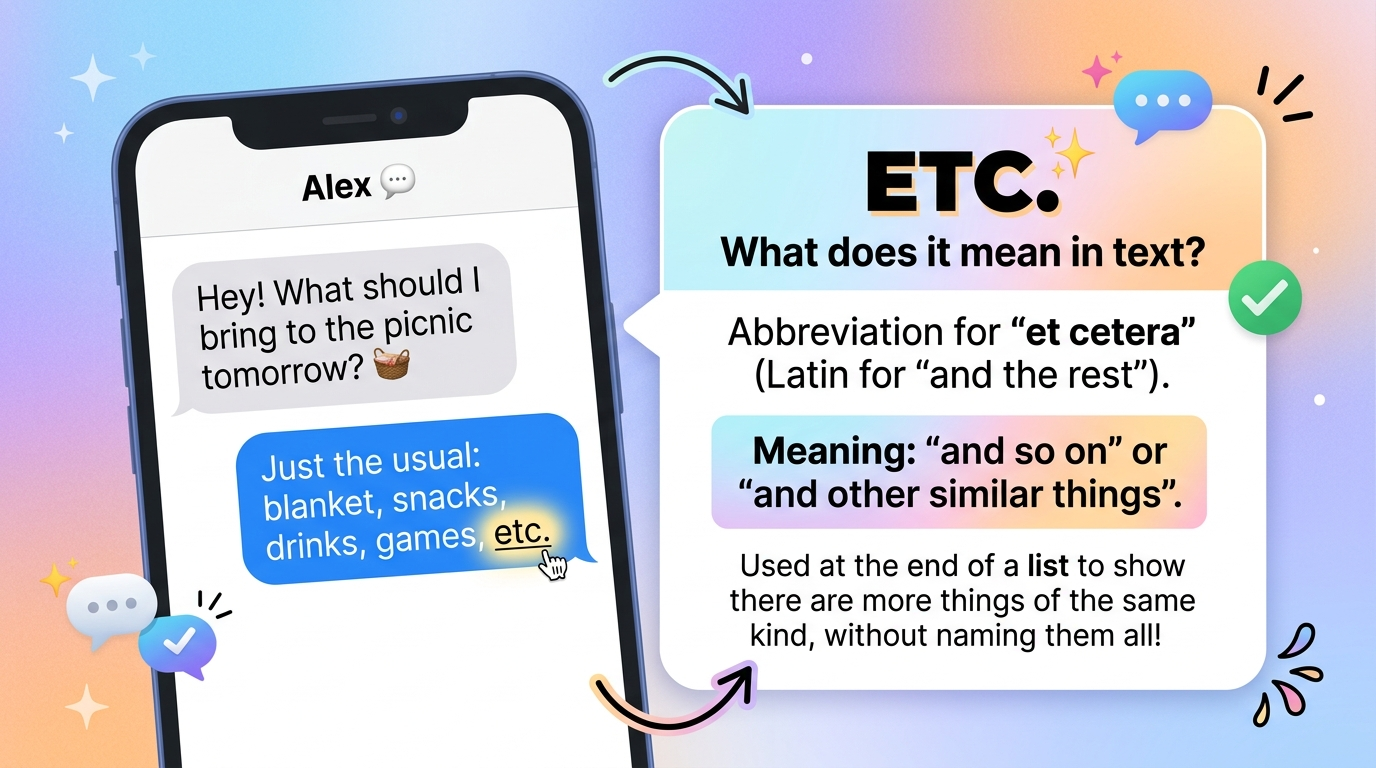
Have you ever received a text message like “Bring snacks, drinks, plates, etc.” and wondered what the last three letters mean? The abbreviation ETC means “et cetera,” which translates to “and so on,” “and the rest,” or “and other similar things.” People use it in text messages, social media conversations, emails, and everyday writing to avoid listing every single item.
Although ETC frequently appears in texting, it is not modern internet slang. It is a traditional abbreviation derived from Latin that has been used in English for centuries.
For example, if your friend texts, “I enjoy movies, music, gaming, etc.,” they mean they enjoy those activities and other similar things.
In this guide, you will learn the meaning of ETC in text messages, how to use it naturally, what it means on social media, how to respond, and which common grammar mistakes to avoid.
What Does ETC Mean in Text?
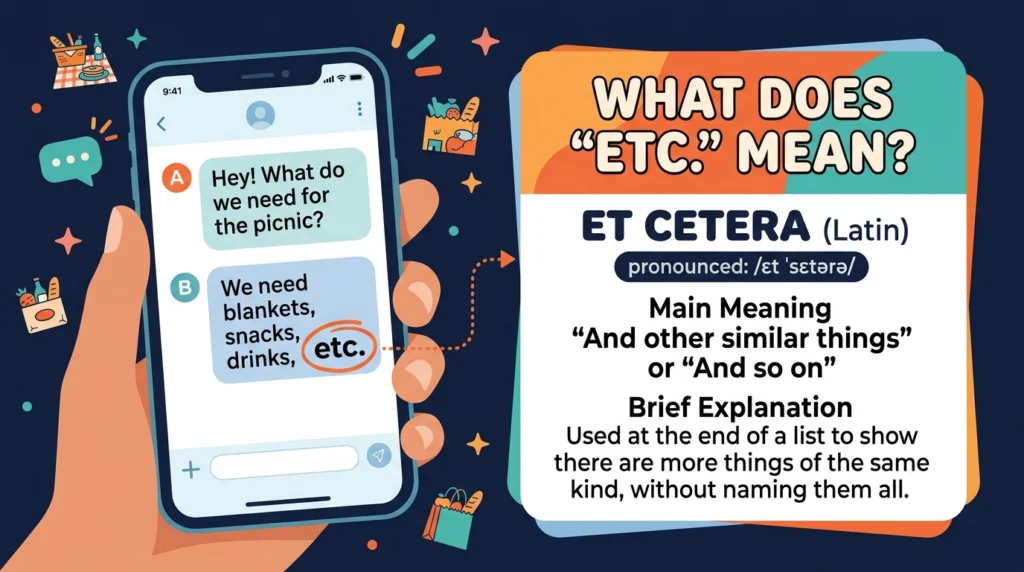
ETC stands for et cetera, a Latin expression meaning “and other things” or “and so on.”
When someone writes ETC at the end of a list, they indicate that additional similar items exist but do not need to be mentioned individually.
Example:
- Text: “I need a notebook, pens, pencils, etc.”
- Meaning: The person needs those items and other similar school supplies.
Another example:
- Text: “We talked about work, family, relationships, etc.”
- Meaning: They discussed those subjects and other related topics.
The exact meaning remains the same whether you see ETC in a text message, an Instagram caption, a WhatsApp conversation, or an email. Context helps you understand which additional things the sender has in mind.
What Is the Full Form of ETC?
The full form of ETC is et cetera.
The expression comes from Latin and refers to the remaining things in a group or list.
| Term | Meaning |
| ETC | Et cetera |
| Literal idea | And the rest |
| Simple meaning | And so on |
| Common purpose | Shortening a list |
| Type | Traditional abbreviation |
For example, “I bought apples, bananas, oranges, ETC” means the person bought those fruits and other similar items.
In everyday digital communication, people frequently write “etc” without a period. In standard English writing, “etc.” is the conventional form.
Is ETC Texting Slang or a Normal Abbreviation?
ETC is a standard abbreviation rather than a modern slang expression.
Unlike internet abbreviations such as LOL (laughing out loud) or BRB (be right back), ETC was already part of written English long before smartphones and social media existed.
People use it in both informal and more structured communication.
- Text messages: To shorten everyday lists.
- Social media: To keep captions and comments concise.
- Schoolwork: To indicate additional examples when appropriate.
- Emails: To summarize related items.
- Work chats: To avoid writing out every item in a familiar category.
Although ETC is widely understood, it should not replace important details when a complete list is necessary.
ETC Meaning in Different Texting Situations
The meaning of ETC generally stays the same across platforms, but the surrounding conversation determines what the unlisted items are likely to be.
1. ETC in WhatsApp Messages
On WhatsApp, ETC often appears when someone is discussing shopping, family plans, school, or everyday tasks.
Example:
A: “What should I bring to the picnic?”
B: “Juice, sandwiches, fruit, etc.”
Meaning: Bring those items and other suitable picnic supplies.
2. ETC on Instagram
On Instagram, people use ETC in direct messages, comments, and captions to mention several interests or activities without creating a long list.
Example:
“Coffee, sunsets, good music, etc. That’s my kind of weekend.”
Meaning: These are some of the things The Person Enjoys, along with other similar experiences.
3. ETC on Snapchat
On Snapchat, ETC can appear in casual conversations about plans, hobbies, or daily routines.
Example:
“School, homework, practice, etc. I’m exhausted.”
Meaning: The person has been busy with these and other related activities.
4. ETC on TikTok
On TikTok, ETC may appear in comments, video descriptions, and captions when creators list interests, trends, or activities.
Example:
“GRWM, outfit ideas, skincare, etc.”
Meaning: The creator is referring to those content categories and other similar ones.
5. ETC in Text Messages Between Friends
Friends often use ETC because they assume the other person understands the general category.
Example:
“I spent the whole day cleaning, cooking, organizing, etc.”
Meaning: The person completed those tasks and other related chores.
6. ETC in Work Chats and Emails
In professional conversations, ETC may shorten a list of related tasks, documents, or supplies.
Example:
“Please review the budget, timeline, deliverables, etc. before our meeting.”
Meaning: Review those items and other relevant materials.
If the recipient needs to know exactly what to prepare, however, it is better to provide a complete list instead of relying on ETC.
Real-Life Examples of ETC in Text With Meanings
Here are practical examples showing how ETC appears in everyday communication.
| Text message | What it means |
| “Bring chips, drinks, etc.” | Bring snacks and other related supplies. |
| “I love cats, dogs, birds, etc.” | I like those animals and others. |
| “We discussed school, exams, etc.” | We discussed those and related topics. |
| “I need milk, bread, eggs, etc.” | I need those groceries and more. |
| “She enjoys painting, reading, etc.” | She enjoys those and similar hobbies. |
| “Pack clothes, shoes, toiletries, etc.” | Pack those things and other useful items. |
| “We watched comedies, dramas, etc.” | We watched those and other types of shows. |
| “I use Instagram, TikTok, etc.” | I use those and other similar platforms. |
| “He bought a laptop, keyboard, etc.” | He bought those items and related equipment. |
| “We need chairs, tables, decorations, etc.” | We need those and other event supplies. |
The important point is that ETC does not identify the missing items individually. It signals that more related examples could be included.
What Does ETC Mean From a Guy or a Girl?
ETC does not have a special gender-specific meaning. Whether a guy or a girl uses it, the abbreviation normally means “and so on.”
However, the surrounding message may communicate a different tone or intention.
When a Guy Uses ETC
Example: “I like Gaming, Football, Movies, etc.”
Meaning: He enjoys those activities and other similar interests.
If he writes, “We could get coffee, walk around, etc.,” he is suggesting those activities and potentially other plans. The abbreviation itself does not prove romantic interest.
When a Girl Uses ETC
Example: “I love shopping, makeup, fashion, etc.”
Meaning: She is referring to those interests and other related activities.
If she texts, “We need to talk about school, plans, etc.,” she means those topics and possibly others.
Does ETC Mean Someone Is Bored?
Not necessarily. A person may use ETC simply because the rest of the list is obvious or unimportant.
For instance, “I bought bread, milk, eggs, etc.” is a normal way to shorten a shopping list. It does not automatically indicate boredom, annoyance, or disinterest.
Tip: Interpret the complete message, the conversation history, and the relationship rather than assuming ETC carries a hidden emotional meaning.
What Does ETC Mean in a Flirty or Romantic Conversation?
ETC does not inherently mean anything romantic or flirtatious. Its meaning depends on the words surrounding it.
Consider these examples:
Example 1:
“I like your smile, your laugh, your eyes, etc.”
Meaning: The sender likes those qualities and other things about you. Depending on your relationship, this could sound affectionate or flirtatious.
Example 2:
“We should go on dates, travel together, etc.”
Meaning: The sender is mentioning possible shared activities. The romantic implication comes from the overall message, not from ETC.
Example 3:
“You know, I Like Spending Time With You, talking with you, etc.”
Meaning: The person is listing positive experiences but leaving other details unstated.
If you are unsure whether a message is flirting, look at the complete conversation and ask a direct, friendly question when appropriate.
How to Reply When Someone Uses ETC in a Text
Your response depends on whether the message is clear or whether you need additional information.
| Situation | Possible reply |
| You understand the list | “Got it!” |
| Someone mentions shopping | “Okay, anything else I should get?” |
| Someone discusses plans | “Sounds good. What else are you thinking?” |
| A friend lists hobbies | “Nice! What else do you enjoy?” |
| A work message is vague | “Could you share the complete list?” |
| Someone suggests activities | “That sounds fun. Let’s plan the details.” |
| You need clarification | “What other things do you mean?” |
You do not need to respond to ETC itself. Simply reply to the main point of the message.
For example:
Friend: “Bring drinks, snacks, plates, etc.”
You: “Sure! I’ll bring those. Do we need anything specific?”
This response acknowledges the message while clarifying any missing details.
ETC vs. Similar Abbreviations: What Is the Difference?
ETC is often confused with other abbreviations because they can appear in the same sentence. Understanding their differences helps you use them correctly.
| Abbreviation | Full form | Main use |
| ETC | Et cetera | Indicates additional similar things |
| E.G. | Exempli gratia | Introduces examples |
| I.E. | Id est | Clarifies or restates something |
| AKA | Also known as | Gives another name |
| ET AL. | Et alii / et alia | Refers to additional people or authors |
| FYI | For your information | Shares information |
| IMO | In my opinion | Introduces a personal opinion |
ETC vs. E.G.
ETC indicates that a list continues. E.G. introduces examples.
- ETC: “I enjoy outdoor activities like hiking, cycling, swimming, etc.”
- E.G.: “I enjoy outdoor activities, e.g., hiking and cycling.”
The first indicates additional similar activities. The second provides examples of outdoor activities.
ETC vs. I.E.
ETC adds the idea of other similar items, whereas I.E. clarifies exactly what the writer means.
- ETC: “Bring writing supplies: pens, Pencils, markers, etc.”
- I.E.: “Bring one writing tool, i.e., a pen.”
The second example restates or specifies the intended meaning rather than adding more examples.
ETC vs. ET AL.
ETC is generally used for additional things, while ET AL. is used for additional people or contributors, particularly in academic citations.
For example, “Smith et al.” can refer to Smith and other authors. It is not interchangeable with ETC in a reference to a group of researchers.
Grammar Rules: How to Use ETC Correctly
Although ETC is easy to understand, a few basic writing rules make your messages clearer.
1. Put ETC at the End of a List
Correct: “I bought apples, oranges, bananas, etc.”
Incorrect: “I bought etc. apples, oranges, bananas.”
ETC normally follows the examples it summarizes.
2. Avoid Writing “And ETC”
The phrase “and etc.” is generally redundant because the word et in et cetera already means “and.”
Correct: “Bring books, notebooks, pens, etc.”
Avoid: “Bring books, notebooks, pens, and etc.”
3. Use a Period in Standard Writing
The conventional spelling is “etc.” because it abbreviates a longer expression.
In informal texts, people sometimes write “etc” without the period. The version without a period is common in casual digital communication, but “etc.” is the standard choice in edited English prose.
4. Do Not Use ETC for Unrelated Items
ETC works best when the omitted items belong to the same general category.
Clear: “Pack shirts, trousers, socks, etc.”
Unclear: “Pack shirts, politics, happiness, etc.”
The second list mixes unrelated concepts, making it difficult to determine what additional items are intended.
5. Do Not Use ETC When Details Are Essential
If you are providing medical instructions, legal requirements, safety directions, or an exact work checklist, list the required items explicitly.
For example, “Bring your identification, completed form, and payment receipt” is more useful than ending the instructions with ETC when every requirement matters.
6. Avoid Repeating ETC Unnecessarily
Writing “pens, pencils, notebooks, etc., and other things” may be unnecessarily repetitive. Choose one clear way to show that the list continues.
Is ETC Formal or Informal?
ETC can be used in both casual and professional communication, but its suitability depends on the situation.
Informal communication: ETC is natural in text messages, casual emails, and everyday notes.
Professional communication: It can be useful when the remaining examples are obvious, although clarity should come first.
Academic writing: Follow the required style guide. Some formal styles restrict or discourage ETC when a precise list would be more helpful.
Official instructions: Avoid ETC if readers need to know every required item or action.
The best rule is simple: use ETC when the additional examples are understood and unimportant to specify individually. Write them out when accuracy matters.
Other Meanings of ETC Outside Texting
Although “et cetera” is the usual meaning in everyday messages, the same letters can have different meanings in specialized contexts.
| Meaning | Context |
| Et cetera | Everyday writing and text messages |
| Electronic Toll Collection | Road toll systems |
| Estimated Time to Completion | Some project-management and technical contexts |
| European Travel Commission | European tourism and travel promotion |
These meanings are context-dependent, and technical definitions can vary by industry.
For example, if someone texts, “Bring your charger, notebook, etc.,” they almost certainly mean et cetera. If a technical report discusses an ETC value for a project, the abbreviation might refer to an estimated time to completion.
When ETC appears in capital letters in a specialized document, check the surrounding subject before deciding what it means.
Peple Also Ask
ETC means “et cetera,” or “and so on.” It indicates that additional similar items exist but do not need to be listed individually.
ETC stands for the Latin expression et cetera, meaning “and the rest” or “and other similar things.”
No. ETC is a traditional abbreviation that people use in both casual and formal writing, although its suitability depends on the context.
On WhatsApp, ETC usually means “and so on.” For example, “Bring drinks, snacks, plates, etc.” refers to those items and other similar supplies.
It normally has the same meaning as elsewhere: “and other similar things.” It may appear in captions, comments, stories, or direct messages
Conclusion
The meaning of ETC in text is straightforward: ETC stands for “Et Cetera,” meaning “and so on” or “and other similar things.” People use it in everyday messages, WhatsApp chats, Instagram captions, emails, and professional communication to shorten lists.
It is not primarily internet slang, and its basic meaning usually remains the same across platforms. The key is to understand the context, recognize which category the list belongs to, and avoid assuming that ETC carries a hidden emotional or romantic message.
Use ETC when the additional examples are easy to understand and do not need to be specified. When accuracy or completeness matters, write out the full list instead.