Introdution
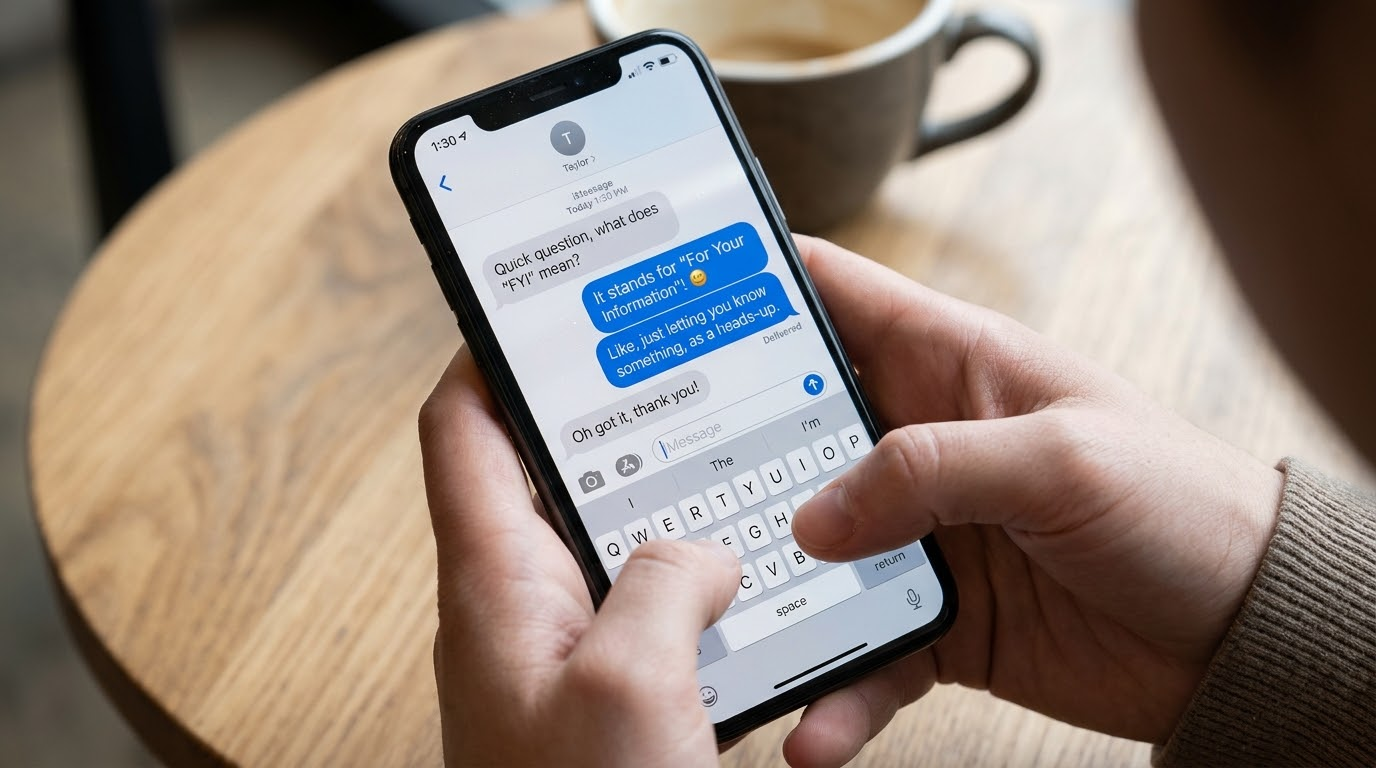
In texting, FYI stands for “For Your Information.” It is used when someone wants to share information, provide an update, give a reminder, or make another person aware of something.
For example:
- “FYI, your package arrived.”
- “FYI, we’re meeting at 5 PM.”
- “FYI, I already sent you the pictures.”
- “FYI, the store closes early today.”
In each example, the sender is sharing information rather than directly asking a question or requesting an action.
FYI is not necessarily slang. It is a widely recognized abbreviation used in everyday communication, including professional emails and casual text messages.
definition in the Cambridge English Dictionary+1
FYI at a glance
| Detail | Meaning |
| Abbreviation | FYI |
| Full form | For Your Information |
| Main purpose | Sharing information |
| Communication style | Casual or professional |
| Typical tone | Neutral and informative |
| Reply required? | Not always |
| Common platforms | SMS, WhatsApp, Instagram, Snapchat, email |
What Does FYI Stand For?
FYI stands for For Your Information. It is a shortened expression that introduces information someone believes another person should know.
The abbreviation is useful because it communicates the purpose of a message without requiring a lengthy introduction.
Consider these examples:
- Without FYI: “I wanted to tell you that tomorrow’s class has been canceled.”
- With FYI: “FYI, tomorrow’s class has been canceled.”
Both communicate the same information, but the second is shorter and more direct.
FYI is commonly used in:
- Text messages between friends.
- Workplace emails and announcements.
- Group conversations.
- Social media comments.
- Shared documents and forwarded messages.
- Online communities and gaming chats.
What Does FYI Mean When Someone Texts You?
When someone sends you FYI, they generally want to bring something to your attention.
The exact intention depends on the information they share and your relationship with the sender.
Here are some common reasons someone might text FYI.
1. Sharing Useful Information
Someone may use FYI to give you information that could help you.
Example:
“FYI, your favorite restaurant is offering a discount today.”
Meaning: The sender thinks you might appreciate knowing about the discount.
2. Giving You a Quick Update
FYI can introduce an update about plans, events, or changes.
Example:
“FYI, we’re leaving 30 minutes earlier.”
Meaning: The sender wants you to know about the change.
3. Reminding You About Something
People also use FYI to remind someone about an important detail.
Example:
“FYI, your assignment is due tomorrow.”
Meaning: The sender is reminding you of the deadline.
4. Correcting a Misunderstanding
Sometimes someone uses FYI before correcting incorrect information.
Example:
“FYI, the event starts at 7 PM, not 8 PM.”
Meaning: The sender is clarifying the correct information.
5. Sharing Something Without Expecting a Reply
FYI can simply mean that someone is keeping you informed.
Example:
“FYI, I’ve uploaded the pictures.”
Meaning: The sender is letting you know the pictures are available.
How Is FYI Used on Snapchat, Instagram, TikTok, and WhatsApp?
FYI generally keeps the same meaning across social media platforms: For Your Information. However, the type of information and conversational tone can change depending on the platform.
FYI Meaning on Snapchat
On Snapchat, FYI is commonly used in direct messages and casual conversations to share quick updates.
Examples:
- “FYI, I’m not coming tonight.”
- “FYI, your streak is about to expire.”
- “FYI, I saved your picture.”
- “FYI, we’re meeting after school.”
It usually sounds like a casual heads-up between friends.
FYI Meaning on Instagram
On Instagram, people use FYI in direct messages, comments, captions, and story replies.
Examples:
- “FYI, I changed my username.”
- “FYI, the link is in my bio.”
- “FYI, this picture was taken last summer.”
- “FYI, that account is fake.”
It can introduce helpful information, additional context, or a correction.
FYI Meaning on TikTok
On TikTok, FYI often appears in video comments, captions, and private messages.
Examples:
- “FYI, this trend started years ago.”
- “FYI, you can find the original video on their page.”
- “FYI, this trick works on Android too.”
It is often used to share Facts, explain something, or correct a misunderstanding.
FYI Meaning on WhatsApp
WhatsApp users frequently use FYI in individual chats and group conversations.
Examples:
- “FYI, dinner is at 8 tonight.”
- “FYI, the electricity will be off tomorrow.”
- “FYI, I’ve shared the documents in the group.”
It helps people communicate important information quickly without writing long messages.
FYI Meaning in Email and Workplace Chat
In professional communication, FYI is used to share information that colleagues, employees, or managers should know.
Examples:
- “FYI, the meeting has been rescheduled.”
- “FYI, I’ve attached the updated report.”
- “FYI, the client approved the proposal.”
It is especially useful when forwarding emails, sharing documents, and providing workplace updates. Cambridge also recognizes this professional and informational usage.
definition in the Cambridge English Dictionary+1
What Does FYI Mean in Different Situations?
Although FYI has one standard full form, the message can communicate different intentions depending on the situation.
| Situation | Example | Intended meaning |
| Friendly | FYI, your favorite show is back! | Sharing good news |
| Informative | FYI, the shop closes at 9. | Giving information |
| Reminder | FYI, your appointment is tomorrow. | Reminding you |
| Warning | FYI, the road is blocked. | Giving a heads-up |
| Corrective | FYI, that’s the wrong address. | Correcting a detail |
| Professional | FYI, the report is ready. | Sharing a work update |
| Playful | FYI, you owe me coffee! | Joking around |
| Annoyed | FYI, I already told you yesterday. | Expressing frustration |
The important thing to remember is that FYI itself does not automatically communicate anger, affection, or sarcasm. The surrounding words and relationship determine how it feels.
Is FYI Rude, Sarcastic, or Passive-Aggressive?
No, FYI is not inherently rude. Most of the time, it is simply a neutral way to share information.
However, certain messages can make it sound blunt, sarcastic, or passive-aggressive.
When FYI Sounds Friendly
When someone shares helpful information, FYI usually feels thoughtful.
Example:
“FYI, I saved you a seat!”
This sounds friendly because the sender is doing something considerate.
When FYI Sounds Neutral
When someone provides a straightforward update, the abbreviation usually has no emotional meaning.
Example:
“FYI, the meeting starts at 10 AM.”
The sender is simply sharing information.
When FYI Sounds Rude
FYI may feel rude when someone uses it to criticize, blame, or embarrass another person.
Example:
“FYI, you made the same mistake again.”
The wording can make the message sound confrontational.
When FYI Sounds Passive-Aggressive
A message may feel passive-aggressive when the sender uses FYI to emphasize something they believe you should already know.
Example:
“FYI, I already explained this three times.”
This suggests frustration rather than a friendly reminder.
When FYI Sounds Sarcastic
FYI can also introduce an obvious fact as a joke or sarcastic comment.
Example:
“FYI, water is wet!”
The meaning depends on the conversation and the sender’s sense of humor.
How to understand the tone
Don’t judge a message by FYI alone. Look at the complete sentence, punctuation, emojis, previous messages, and your relationship with the sender.
How to Reply to FYI in a Text
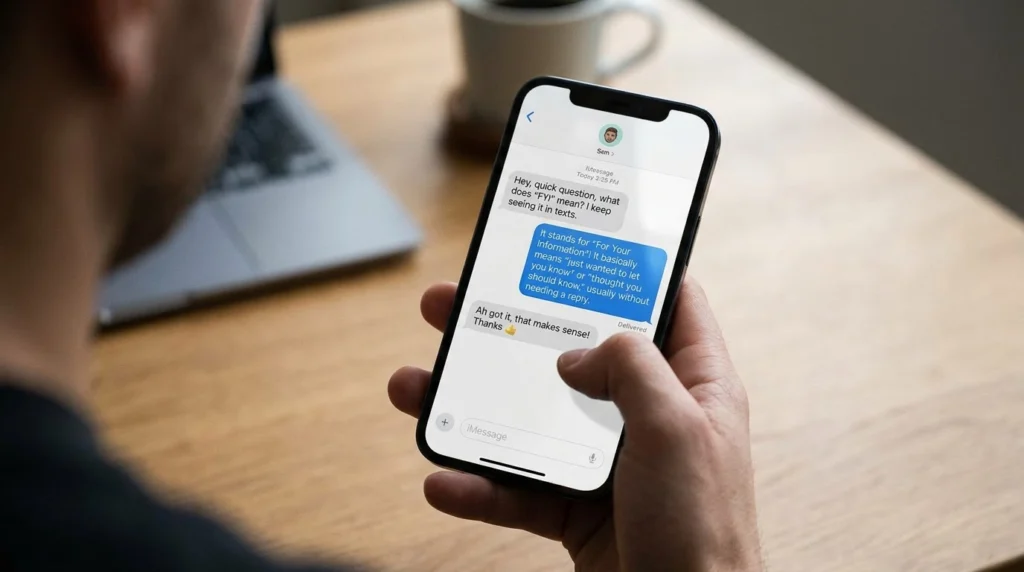
You do not always need to respond to FYI. However, acknowledging the information is a good idea when it affects your plans, responsibilities, or decisions.
Here are some natural responses.
Friendly Replies to FYI
Use these when a friend or family member shares something helpful.
- “Thanks for letting me know!”
- “Oh, good to know!”
- “Thanks for the heads-up.”
- “I appreciate it!”
- “That’s helpful, thanks!”
Casual Replies to FYI
These short responses work well in everyday conversations.
- “Got it!”
- “Okay, cool.”
- “Noted.”
- “Alright, thanks.”
- “Sounds good.”
Professional Replies to FYI
Use these when communicating with coworkers, Managers, or clients.
- “Thank you for the update.”
- “Noted, thank you.”
- “I appreciate the information.”
- “Thanks for sharing.”
- “Understood. I’ll keep that in mind.”
Funny Replies to FYI
If someone sends you a playful FYI message, you can respond humorously.
- “Thanks for the breaking news!”
- “Well, that’s good to know 😂”
- “My information department appreciates this!”
- “FYI, I already knew that!”
- “Thanks for keeping me informed 🤣”
Replies When FYI Sounds Rude
If the message feels slightly aggressive, respond calmly instead of escalating the conversation.
- “Okay, understood.”
- “Thanks for clarifying.”
- “I got your point.”
- “No worries, I’ll keep that in mind.”
- “Understood. Let’s move forward.”
The best reply depends on what the sender is communicating, not just the abbreviation.
FYI Examples in Real Conversations
Here are realistic examples showing how FYI appears in different types of conversations.
Example 1: Between Friends
Alex: Are we meeting today?
Sam: FYI, the plan changed to tomorrow.
Alex: Oh okay, thanks for telling me!
Meaning: Sam is informing Alex about a change in plans.
Example 2: In a WhatsApp Group
Ali: FYI, the electricity will be off from 2 PM to 5 PM.
Sara: Thanks for the update.
Meaning: Ali is sharing useful information with everyone.
Example 3: On Snapchat
Mia: FYI, I posted the pictures from yesterday.
Emma: Going to check them now!
Meaning: Mia is letting Emma know that the pictures are available.
Example 4: In a Workplace Chat
Manager: FYI, the client has approved the new design.
Employee: Great, thank you for the update.
Meaning: The manager is sharing a professional update.
Example 5: Between Couples
Noah: FYI, I booked our favorite restaurant for Saturday ❤️
Olivia: Aww, that’s so sweet!
Meaning: Noah is sharing a thoughtful update.
Example 6: During an Argument
Jake: FYI, I already told you about the deadline.
Ryan: Okay, I understand. I’ll check It Again.
Meaning: Jake sounds frustrated because he believes he has already explained something.
Example 7: In an Instagram DM
Lily: FYI, that’s my old account. I don’t use it anymore.
Maya: Got it! Thanks for letting me know.
Meaning: Lily is clarifying information about her account.
Example 8: In a School Conversation
Ben: FYI, our teacher moved the test to Friday.
Chris: Really? Thanks for telling me!
Meaning: Ben is sharing an important school update.
Example 9: In a Gaming Chat
Player 1: FYI, the server is down right now.
Player 2: Okay, I’ll try again later.
Meaning: The sender is informing teammates about a technical issue.
Example 10: A Playful Conversation
Ella: FYI, you still owe me ice cream 😂
Mike: I haven’t forgotten! Next weekend?
Meaning: Ella is jokingly reminding Mike about something.
FYI vs. BTW vs. FYR vs. FYA
FYI is sometimes confused with other abbreviations because they are all used to share information. However, each has a slightly different purpose.
| Abbreviation | Full Form | Meaning |
| FYI | For Your Information | Sharing information |
| BTW | By The Way | Introducing an additional point |
| FYR | For Your Reference | Providing something to consult |
| FYA | For Your Action | Indicating that action is needed |
| ICYMI | In Case You Missed It | Sharing something again |
| JSYK | Just So You Know | Giving someone a heads-up |
| TMI | Too Much Information | Sharing excessive personal details |
FYI vs. BTW
It introduces information someone should know, while BTW introduces an additional thought or subject.
- FYI: “FYI, the meeting starts at 3 PM.”
- BTW: “BTW, did you call your brother?”
FYI vs. FYR
It shares information for awareness, while FYR provides something for future consultation or reference.
- FYI: “FYI, the office will close early.”
- FYR: “FYR, here’s a copy of the employee handbook.”
FYI vs. FYA
FYI usually communicates information without directly requesting action. FYA indicates that the recipient should take action.
- FYI: “FYI, the report is attached.”
- FYA: “FYA, please review the attached report.”
Remember that workplace abbreviations can have organization-specific usage, so context is important.
When Should You Use FYI?
FYI is useful when you want to share information quickly and clearly without writing a long explanation.
Here are some situations where using it makes sense:
- Sharing Updates: Let someone know about a change in plans.
- Giving reminders: Bring an upcoming deadline or event to someone’s attention.
- Forwarding information: Share an email, document, or important announcement.
- Correcting details: Politely clarify incorrect information.
- Group communication: Keep multiple people informed about the same update.
- Workplace messaging: Provide colleagues with information they may need.
When Should You Avoid Using FYI?
Although FYI is widely accepted, it may not be suitable for every situation.
Avoid using it when:
- Someone needs emotional support or sympathy.
- You are delivering sensitive or upsetting news.
- You want to make a sincere apology.
- The message could sound like criticism.
- You are communicating in a highly formal situation where a complete sentence would be more appropriate.
For a warmer tone, use phrases such as “Just wanted to let you know” or “I thought you should know.”
Common Mistakes to Avoid When Using FYI
Even though FYI is simple, people sometimes misunderstand its purpose.
1. Assuming FYI always means something negative
FYI is not automatically rude or aggressive. It usually introduces information.
2. Thinking FYI requires an immediate response
Most FYI messages are informational. A response is helpful when acknowledgment or action is appropriate, but not always necessary.
3. Confusing FYI with FYA
FYI communicates information, whereas FYA suggests that the recipient should take action.
4. Using FYI without enough context
A message containing only “FYI” may leave the recipient wondering what they are supposed to know. Include the relevant information whenever possible.
5. Assuming capitalization changes the meaning
FYI, fyi, and Fyi generally communicate the same thing. Capitalization is usually a matter of writing style.
People Also Ask
FYI means “For Your Information.” It is used to share updates, reminders, helpful details, or information someone should know.
FYI stands for “For Your Information.” It is a common abbreviation used in texting, emails, social media, and professional communication.
No, FYI is not inherently rude. However, it can sound blunt or passive-aggressive when used in a critical or argumentative message.
On Snapchat, FYI means “For Your Information.” People use it to share quick updates, reminders, and useful details with friends.
On Instagram, FYI is used in DMs, comments, captions, and story replies to provide additional information or clarify something.
Conclusion
FYI means “For Your Information” in texting, social media, emails, and everyday conversations. People use it to share helpful information, provide updates, give reminders, and make others aware of something important.
Although its basic meaning stays the same across platforms such as Snapchat, Instagram, TikTok, and WhatsApp, its tone can change depending on the situation. It may sound friendly, neutral, professional, or occasionally sarcastic.
The next time someone sends you FYI, remember that they are usually just trying to keep you informed. A simple response like “Got it,” “Thanks for letting me know,” or “Good to know!” is often enough.