Introduction
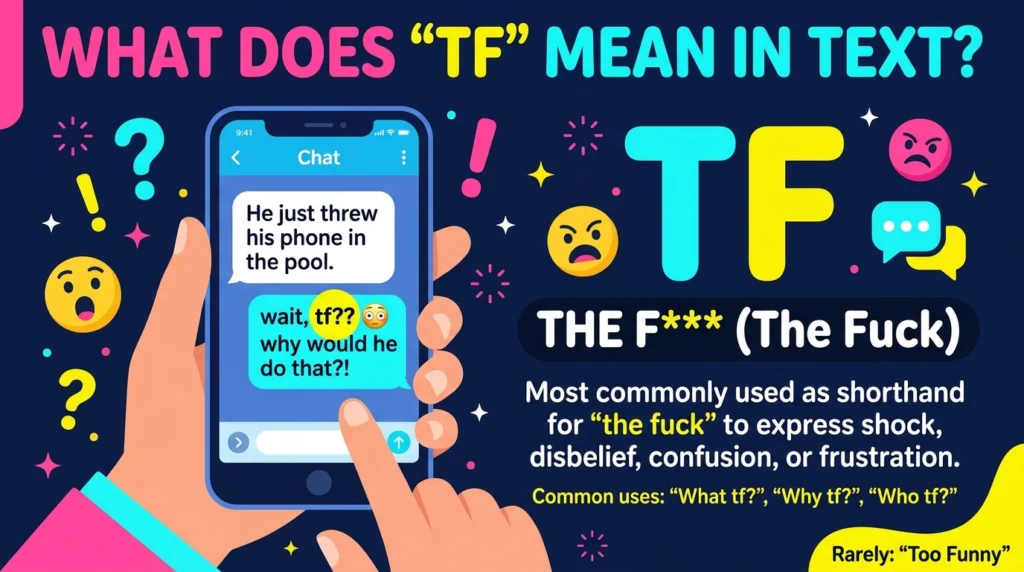
TF usually means “The Fuck” in text messages, online chats, and social media conversations. It is an informal internet abbreviation people use to express surprise, confusion, frustration, disbelief, or strong emotion.
Instead of typing the complete phrase, people use TF to make their messages shorter while keeping the same emotional impact.
For example:
- “What TF is going on?” means “What the fuck is going on?”
- “Who TF is that?” expresses surprise or curiosity.
- “Why TF did you do that?” shows frustration or disbelief.
- “How TF did you manage that?” expresses amazement.
The meaning of TF depends on the conversation and the person’s tone. Sometimes it sounds funny or playful between close friends, while other times it can sound aggressive or disrespectful.
You may encounter TF on Snapchat, Instagram, TikTok, WhatsApp, Facebook, Discord, and other messaging platforms.
Quick takeaway: TF is an informal abbreviation for “the fuck.” It adds emphasis to questions, reactions, and statements, especially when someone feels surprised, confused, annoyed, or shocked.
What Does TF Stand For?
TF stands for “the fuck.” It is an internet slang expression that works as an intensifier, meaning it makes a sentence sound stronger or more emotional.
The abbreviation is particularly common in casual digital conversations because people often prefer short expressions when messaging friends.
Here is a quick breakdown:
| Term | Meaning | Usage |
| TF | The fuck | Expressing strong emotion |
| WTF | What the fuck | Showing shock or disbelief |
| WTH | What the heck | A milder expression |
| AF | As fuck | Adding strong emphasis |
| FR | For real | Showing agreement or sincerity |
| IDK | I don’t know | Expressing uncertainty |
Although TF is shorter than the complete expression, it still carries profanity. Therefore, it is important to understand your audience before using it.
TF Meaning in Different Texting Situations
TF does not communicate only one emotion. Its meaning changes according to the words surrounding it, punctuation, emojis, and the relationship between the people chatting.
Here are the most common situations in which people use TF.
1. TF Meaning as Surprise
People use TF when something unexpected happens or when they cannot believe what they are seeing.
Example:
Friend 1: I just won a free trip to Dubai!
Friend 2: TF! Are you serious?
Here, TF expresses surprise and excitement.
2. TF Meaning as Confusion
TF can also show that someone does not understand a situation or wants an explanation.
Example:
Person 1: I changed the entire schedule.
Person 2: TF is happening here?
In this conversation, the abbreviation communicates confusion.
3. TF Meaning as Anger or Frustration
When someone is upset, TF can make their message sound stronger and more direct.
Example:
Person 1: I deleted your project accidentally.
Person 2: Why TF would you do that?
Here, TF emphasizes frustration and annoyance.
4. TF Meaning as Disbelief
Sometimes people use TF when something sounds unbelievable or difficult to accept.
Example:
Friend 1: He finished the entire assignment in ten minutes.
Friend 2: How TF?
The expression communicates disbelief and amazement.
5. TF Meaning as a Joke
Among close friends, TF can be used humorously without expressing genuine anger.
Example:
Friend 1: I ate pizza for breakfast.
Friend 2: TF 😂 You never change!
Here, the abbreviation adds a playful reaction.
How Is TF Used on Social Media?
TF appears across different social media platforms. Although its main meaning generally stays the same, the surrounding conversation can influence its tone.
TF Meaning on Snapchat
On Snapchat, TF usually means “the fuck.” People use it in private messages, group chats, Snap replies, and conversations with friends.
Examples:
- “TF are you doing?”
- “Who TF added me?”
- “TF 😂 I wasn’t expecting that.”
- “Why TF did you delete our streak?”
A message containing TF may express curiosity, surprise, annoyance, or playful confusion.
TF Meaning on Instagram
On Instagram, users commonly write TF in comments, captions, direct messages, and replies to Reels or Stories.
Examples:
- “What TF is this picture?”
- “How TF did you take this photo?”
- “Who TF made this video?”
- “Why TF is this trending?”
It is often used to react quickly to unusual content or unexpected posts.
TF Meaning on TikTok
TikTok users frequently use TF when reacting to funny videos, unexpected moments, controversial opinions, or surprising trends.
Examples:
- “TF did I just watch?”
- “How TF did this video get so many views?”
- “Why TF is everyone doing this trend?”
- “This is funny TF 😂”
On TikTok, TF can make a comment sound dramatic, humorous, or genuinely confused.
TF Meaning on WhatsApp
On WhatsApp, TF is generally used in personal conversations and group chats.
Examples:
- “Where TF are you?”
- “TF happened last night?”
- “Why TF didn’t you tell me?”
- “What TF are we doing tomorrow?”
The intended emotion depends on the relationship and the discussion.
TF Meaning on Discord and Gaming Chats
Gamers and Discord users use TF to react quickly during multiplayer games, live discussions, and online conversations.
Examples:
- “TF was that move?”
- “How TF did you win?”
- “Who TF joined the server?”
- “What TF happened to our team?”
It is a casual expression that communicates strong reactions without requiring a lengthy message.
20+ TF Meaning in Text Examples
Understanding TF becomes easier when you see how people actually use it in everyday conversations.
The following examples show different meanings, tones, and situations.
| Text Message | Meaning or Emotion |
| What TF? | Surprise or confusion |
| Who TF are you? | Strong curiosity or suspicion |
| Where TF have you been? | Frustration or concern |
| Why TF not? | Confusion or disagreement |
| How TF did you do that? | Amazement |
| TF is going on? | Confusion |
| Get TF out! | Strong command |
| I don’t know TF happened. | Confusion |
| What TF was that? | Shock or disbelief |
| Why TF are you laughing? | Annoyance or curiosity |
| TF 😂 | Playful surprise |
| No TF way! | Disbelief |
| Move TF on. | Impatience |
| This is crazy TF. | Strong emphasis |
| Where TF is my phone? | Frustration |
| Who TF told you? | Suspicion |
| How TF is that possible? | Amazement |
| TF are you talking about? | Confusion or irritation |
| That was weird TF. | Strong reaction |
| TF happened yesterday? | Surprise or curiosity |
Short Conversation Examples
Example 1: Between Friends
Alex: I accidentally sent the message to the wrong person.
Sam: TF 😂 What did you send?
Meaning: Sam is surprised and amused.
Example 2: Showing Frustration
Mike: You forgot our meeting again.
John: Why TF didn’t you remind me?
Meaning: John sounds frustrated or defensive.
Example 3: Expressing Disbelief
Emma: She bought a new car yesterday.
Lisa: TF! How did she afford that?
Meaning: Lisa is surprised and wants more information.
Example 4: Reacting to Something Strange
David: Look at this video.
Chris: TF did I just watch? 😂
Meaning: Chris finds the video strange or funny.
Example 5: Asking for an Explanation
Sarah: I changed my phone number.
Tom: Why TF didn’t you tell me?
Meaning: Tom feels confused or annoyed because he was not informed.
What Does TF Mean From a Guy?
When a guy sends TF in a text message, it generally means “the fuck.” However, the emotion behind it depends on the conversation.
Here are some possible interpretations:
- Surprise: He is shocked by something you said.
- Confusion: He does not understand your message.
- Playfulness: He is joking around with you.
- Annoyance: Something has irritated him.
- Disbelief: He finds your statement difficult to believe.
For example:
You: I stayed awake all night watching movies.
Him: TF 😂 You need some sleep!
In this situation, he is probably joking rather than expressing anger.
However, if he says, “Why TF did you ignore me?” he may be expressing frustration.
What Does TF Mean From a Girl?
When a girl uses TF, it generally has the same meaning as when a guy uses it. It can communicate surprise, confusion, humor, disbelief, or irritation.
Consider these examples:
- “TF are you serious?” — She is surprised.
- “Why TF would you say that?” — She may be annoyed.
- “How TF did you know?” — She is amazed.
- “TF 😂 You’re so funny!” — She is joking or laughing.
- “Who TF is she?” — She may be curious or suspicious.
Important: TF does not automatically indicate flirting, attraction, or anger. Look at the surrounding conversation before assuming what someone means.
Is TF Rude or Offensive?
Yes, TF can be considered rude or offensive because it represents a profanity-based expression. However, how offensive it sounds depends on the situation, relationship, and communication style.
For example, close friends may casually use TF without intending to insult anyone. On the other hand, using it during an argument can make a message sound aggressive.
Consider these differences:
| Situation | Example | Tone |
| Close friends | What TF 😂 | Playful |
| Unexpected news | TF! Really? | Surprised |
| Argument | Why TF did you lie? | Aggressive |
| Professional chat | Who TF approved this? | Unprofessional |
| Casual gaming | How TF did I lose? | Frustrated |
When Should You Avoid Using TF?
Avoid TF in situations where Respectful or professional communication is important, including:
- Emails to employers or clients.
- Conversations with teachers or supervisors.
- Formal business discussions.
- Messages to people you do not know well.
- Sensitive conversations where profanity may hurt someone.
If you are unsure whether someone is comfortable with slang, choosing a polite alternative is safer.
What Is the Difference Between TF and WTF?
TF and WTF are closely related internet abbreviations. Both contain the same profanity, but their sentence structures and usage are slightly different.
- TF: Means “the fuck.” It usually emphasizes a question or statement.
- WTF: Means “what the fuck.” It is commonly used as a complete reaction to something surprising or confusing.
Here is a comparison:
| Feature | TF | WTF |
| Full form | The fuck | What the fuck |
| Main purpose | Adds emphasis | Expresses a strong reaction |
| Common usage | Why TF? | WTF happened? |
| Tone | Confused, angry, surprised | Shocked, confused, surprised |
| Formality | Informal | Informal |
| Profanity | Yes | Yes |
Example:
- “Why TF are you late?” emphasizes frustration.
- “WTF! You’re late again?” expresses shock or annoyance.
Both are informal and should generally be reserved for casual conversations.
Other Meanings of TF Outside Texting
Although TF most commonly means “the fuck” in everyday internet slang, it can represent different terms in technical, educational, professional, and gaming environments.
The surrounding context helps determine the correct meaning.
| Alternative Meaning | Context | Explanation |
| Task Force | Military and business | A group assigned to complete a specific task |
| Transfer Function | Engineering | Describes the relationship between a system’s input and output |
| TensorFlow | Technology | A machine learning framework |
| TransFlash | Technology | An alternative name associated with microSD memory cards |
| Team Fortress | Gaming | A multiplayer video game franchise |
| Teaching Fellow | Education | An academic teaching position |
| Transformation | Online communities | A change in appearance or form |
For example:
- “The TF will meet tomorrow.” — Could refer to a Task Force.
- “Install TensorFlow for the project.” — Refers to machine learning technology.
- “I need a TF card.” — Refers to a memory card.
These meanings are context-dependent and are not interchangeable with the usual texting slang meaning.
How to Reply When Someone Sends TF?
Your response should depend on why the person used TF. They might be surprised, confused, joking, or irritated.
Here are some natural replies for different situations.
1. If They Are Surprised
If someone sends “TF?!” after hearing unexpected news, you can respond:
- “I know, crazy right?”
- “Yes, I’m serious!”
- “I couldn’t believe it either.”
- “It’s a long story 😂”
2. If They Are Confused
If someone writes “What TF is happening?” you can clarify the situation.
- “Let me explain.”
- “Nothing serious, don’t worry.”
- “I’ll tell you what happened.”
- “It’s a little complicated.”
3. If They Are Angry
If someone says “Why TF did you do that?” avoid escalating the situation.
- “Sorry, I didn’t mean to upset you.”
- “Let me explain what happened.”
- “I understand why you’re frustrated.”
- “It was an honest mistake.”
4. If They Are Joking
If your friend uses TF humorously, you can keep the conversation light.
- “Don’t ask 😂”
- “Long story!”
- “I know, right?”
- “You already know me!”
- “That’s just how it happened.”
5. If You Want to Stay Polite
If you are uncomfortable with profanity, you can respond without using similar language.
- “What do you mean?”
- “Is everything okay?”
- “Can you explain?”
- “Why are you surprised?”
Polite Alternatives to TF
If you want to express surprise, confusion, or frustration without using profanity, several alternatives can communicate the same general emotions.
| Alternative | Meaning or Usage |
| What the heck? | Expressing surprise |
| What on earth? | Showing confusion |
| Seriously? | Expressing disbelief |
| What happened? | Asking for an explanation |
| How is that possible? | Showing amazement |
| Why would you do that? | Questioning someone’s actions |
| Are you kidding me? | Expressing disbelief |
| No way! | Showing surprise |
| What’s going on? | Asking about a situation |
| That’s unbelievable! | Expressing amazement |
These alternatives are generally more appropriate for professional conversations, family discussions, and situations where respectful language matters.
Why Do People Use TF Instead of the Full Phrase?
People use TF because internet conversations are usually fast, Informal, and expressive. Short abbreviations help communicate emotions without typing long sentences.
There are several reasons behind its popularity.
1. Faster Communication: Typing two letters is quicker than writing the complete expression.
2. Emotional Emphasis: TF makes a question or statement sound stronger.
3. Internet Culture: Abbreviations are widely used in memes, comments, online communities, and messaging apps.
4. Casual Expression: Friends often use slang to make conversations feel natural and informal.
5. Censored Appearance: Some people prefer TF because it avoids spelling out the complete profanity, although the implied meaning remains.
Ultimately, TF is more than a typing shortcut. It is a way of expressing an emotional reaction in a short message.
Is TF Still Common in Texting and Social Media?
TF remains a recognizable expression in internet slang and casual digital communication. People use it in text messages, memes, social media comments, gaming conversations, and online discussions.
Its popularity is partly connected to its flexibility. The same abbreviation can express surprise in one conversation, frustration in another, and humor in a third.
However, TF is not appropriate for every audience. Understanding the context and relationship between the people communicating is more important than simply knowing its full form.
People Also Ask
TF usually stands for “the fuck.” It is an informal abbreviation used to express surprise, confusion, frustration, disbelief, or emphasis in text messages.
When a girl uses TF, she generally means “the fuck.” Depending on the conversation, she may be expressing surprise, annoyance, confusion, or playful disbelief.
When a guy texts TF, he usually uses it to emphasize a question or reaction. It does not automatically indicate anger or romantic interest.
They are related but slightly different. TF stands for “the fuck,” while WTF stands for “what the fuck.” Both are used to express strong emotions such as surprise, confusion, or disbelief.
TF represents profanity, so it can be considered inappropriate or offensive in formal situations. However, friends sometimes use it casually without intending to offend anyone.
Conclusion
Understanding TF meaning in text is simple once you know how people use it in everyday conversations. TF usually stands for “the fuck,” an informal internet abbreviation that expresses surprise, confusion, frustration, disbelief, or humor.
You may encounter it on Snapchat, Instagram, TikTok, WhatsApp, Discord, and other social media platforms. Although its meaning generally stays the same, the emotion behind it depends on the situation and the relationship between the people chatting.
Remember that TF contains implied profanity, so it is best suited to casual conversations with people who are comfortable using slang. If you prefer respectful or professional communication, expressions such as “what the heck” or “seriously?” are better alternatives.
Now that you understand TF, its meanings, examples, and common uses, you can recognize it more confidently whenever it appears in your Messages.