Introducution
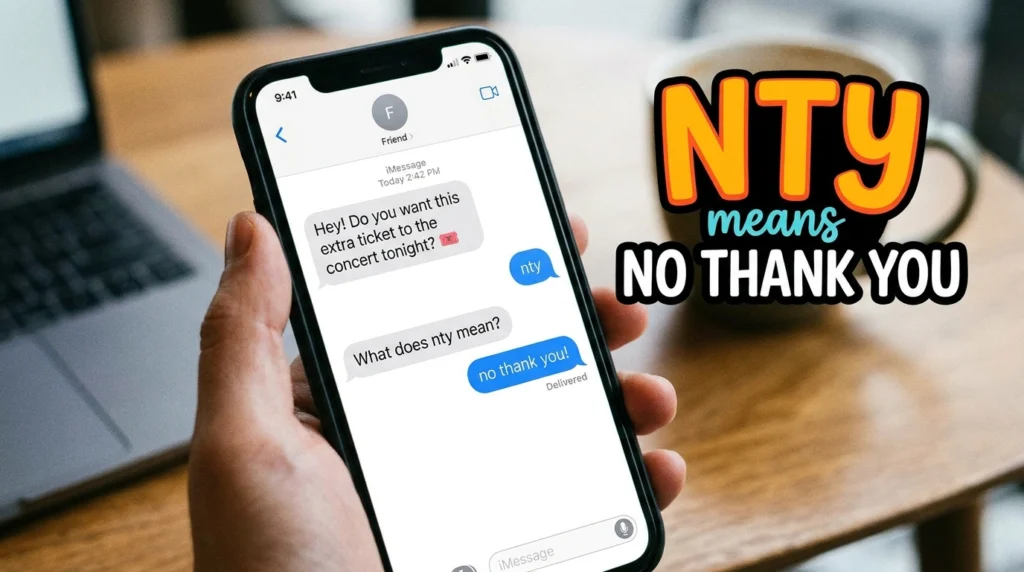
NTY means “No Thank You” in text messages and online conversations. It is a common abbreviation people use when they want to politely decline an offer, invitation, suggestion, or request without typing the complete phrase.
For example:
- Friend: “Do you want to grab some coffee?”
- You: “NTY, I already had some.”
In this conversation, NTY simply means that you appreciate the offer but do not want coffee.
You might encounter this abbreviation in text messages, Snapchat conversations, Instagram DMs, WhatsApp groups, TikTok comments, gaming chats, and online marketplaces.
Although NTY generally communicates a polite refusal, its tone can change depending on the conversation. Sometimes it sounds friendly and respectful, while in other situations, it may feel short, cold, or dismissive.
The easiest way to understand it is to remember that NTY = No Thank You = A polite way to say no.
NTY Meaning at a Glance
| Feature | Explanation |
| Full form | No Thank You |
| Category | Texting abbreviation |
| Main meaning | Politely declining something |
| Tone | Polite, casual, or firm |
| Common usage | Text messages and online chats |
| Uppercase | NTY |
| Lowercase | nty |
| Common platforms | Snapchat, Instagram, TikTok, WhatsApp |
| Best alternative | No thanks, I’m good |
What Does NTY Stand for?
NTY stands for No Thank You.
Each letter represents part of the original expression:
- N: No
- T: Thank
- Y: You
Instead of writing all three words, people combine their first letters to create a shorter response.
For example:
“Would you like another slice of pizza?”
“NTY, I’m full.”
The sender communicates the same message without writing a complete sentence.
NTY is particularly useful in informal conversations where people prefer quick responses. It can also help someone decline an offer without sounding unnecessarily negative.
However, it is important to understand that NTY is not an acceptance. The sender is saying no while acknowledging the other person’s offer.
How Is NTY Used in Different Conversations?
NTY can appear in several types of online conversations. Its central meaning stays the same, but the situation determines what the sender is refusing.
1. Declining an Offer
One of the most common uses of NTY is refusing something someone offers.
Example:
Person A: “Want me to bring you lunch?”
Person B: “NTY, I already ate.”
Here, the person appreciates the offer but does not need anything to eat.
2. Turning Down an Invitation
People also use NTY when they do not want to attend an event or participate in an activity.
Example:
Person A: “Are you coming to the party tonight?”
Person B: “NTY, I’m staying home.”
It communicates that the person does not want to attend.
3. Refusing a Suggestion
NTY can be used when someone recommends an activity, product, or idea that does not interest you.
Example:
Person A: “You should try this new mobile game.”
Person B: “NTY, gaming isn’t my thing.”
The response politely rejects the suggestion.
4. Declining a Purchase or Deal
In online marketplaces, NTY is useful when someone does not want to accept a price, product, or trading offer.
Example:
Buyer: “Would you sell it for $30?”
Seller: “NTY, the price is already fixed.”
Here, NTY means the seller is not interested in the proposed deal.
5. Refusing Unwanted Requests
Sometimes people use NTY to establish a simple personal boundary.
Example:
Person A: “Can I borrow your phone?”
Person B: “NTY, I need it right now.”
The sender refuses the request without making the conversation unnecessarily complicated.
What Does NTY Mean on Snapchat?
On Snapchat, NTY means “No Thank You.” People use it in direct messages, group chats, and replies when they want to decline invitations, suggestions, or offers.
For example:
- Friend: “Want to keep snapping all night?”
- You: “NTY 😂 I’m getting sleepy.”
Another example:
- Person: “Can I add you to our private story?”
- Reply: “NTY, but thanks!”
On Snapchat, the abbreviation is generally casual. An emoji, friendly wording, or short explanation can make it sound less serious.
If someone sends you just “NTY,” they are most likely declining whatever you offered or suggested.
What Does NTY Mean on Instagram?
On Instagram, NTY also stands for “No Thank You.” It commonly appears in direct messages, comments, and conversations where someone wants to reject an invitation, collaboration, or recommendation.
Examples:
- “Want to collaborate on this post?” — “NTY, I’m working on another project.”
- “You should follow this account.” — “NTY, I’m good.”
- “Interested in buying my product?” — “NTY, thanks anyway.”
The meaning does not change between Instagram and regular texting. It remains a short way to communicate a refusal.
What Does NTY Mean on WhatsApp and TikTok?
On WhatsApp: NTY is commonly used in personal messages and group chats to decline plans, offers, or requests.
Example:
“Are you joining us for dinner?”
“NTY, maybe another time.”
On TikTok: NTY may appear in comments and direct messages when someone rejects a recommendation, challenge, trend, or invitation.
Example:
“Try this dance challenge!”
“NTY 😂 I can’t dance.”
In both situations, the abbreviation communicates a simple no while acknowledging the other person’s suggestion.
What Does NTY Mean From a Girl?
When a girl sends NTY, it usually means “No Thank You.” She is politely declining something you offered, suggested, or asked her to do.
For example:
You: “Would you like to go out for dinner?”
Her: “NTY, I’m busy tonight.”
She is declining your invitation. It does not automatically mean she dislikes you or wants to end the conversation.
Consider these possible interpretations:
- Friendly refusal: She appreciates your offer but does not want it.
- Not interested: She does not want to participate in the suggested activity.
- Setting boundaries: She is communicating that something is not comfortable for her.
- Short response: She may simply prefer quick messages.
Always consider the previous conversation rather than assuming NTY has a romantic meaning.
What Does NTY Mean From a Guy?
When a guy texts NTY, he generally means “No Thank You.” He may be refusing an invitation, declining an offer, or showing that he is not interested in a particular suggestion.
For example:
You: “Want to come shopping with me?”
Him: “NTY, I’ve got some work to finish.”
This is a straightforward refusal. It does not necessarily indicate anger, frustration, or a lack of interest in you personally.
Depending on the conversation, NTY can communicate:
- A polite rejection.
- A casual refusal.
- A lack of interest in an activity.
- A desire to avoid something.
- A firm but respectful boundary.
The surrounding words and previous messages help explain his actual intention.
Is NTY Rude or Polite?
NTY is generally considered a polite abbreviation because it stands for “No Thank You.” However, it can sometimes sound blunt because it is shorter than a complete sentence.
The tone depends on how someone uses it.
| Message | Possible Tone | What It Communicates |
| NTY | Neutral | No, thank you |
| NTY 😊 | Friendly | A warm refusal |
| nty lol | Playful | A lighthearted no |
| NTY, I’m good | Polite | No, I don’t need it |
| NTY! | Firm | A clear refusal |
| nty. | Potentially cold | A short, direct rejection |
| NTY, but thanks! | Respectful | Appreciation with a refusal |
When does NTY sound rude?
It may feel rude when:
- Someone sends it during a serious conversation.
- The other person expects a detailed response.
- It is used to dismiss repeated questions.
- The sender does not provide any context in a sensitive situation.
However, a short response does not automatically indicate a negative attitude. Some people naturally prefer brief messages.
15 Real-Life Examples of NTY in Text Messages
The following conversations demonstrate how people use NTY in everyday messaging.
| No. | Conversation | Meaning |
| 1 | “Want some pizza?” — “NTY, I’m full.” | Declining food |
| 2 | “Coming to the movies?” — “NTY, maybe next time.” | Declining plans |
| 3 | “Need a ride?” — “NTY, I have my car.” | Refusing help |
| 4 | “Want to play online?” — “NTY, I’m busy.” | Declining gaming |
| 5 | “Can I call you?” — “NTY, let’s text.” | Declining a call |
| 6 | “Want another drink?” — “NTY, I’m good.” | Refusing a drink |
| 7 | “Join our group?” — “NTY, thanks.” | Declining an invitation |
| 8 | “Interested in this offer?” — “NTY.” | Rejecting an offer |
| 9 | “Want to go shopping?” — “NTY, I’m tired.” | Declining an outing |
| 10 | “Should I send you the link?” — “NTY, I have it.” | Declining assistance |
| 11 | “Try this new trend!” — “NTY 😂” | Playful refusal |
| 12 | “Want to trade items?” — “NTY, I like mine.” | Rejecting a trade |
| 13 | “Can I borrow your jacket?” — “NTY, I need it.” | Refusing a request |
| 14 | “Are you joining the party?” — “NTY, not tonight.” | Declining an event |
| 15 | “Would you like some help?” — “NTY, but I appreciate it.” | Polite refusal |
These examples show that NTY works in different situations, from casual friendships to online transactions.
How to Reply When Someone Texts NTY
If someone sends you NTY, the best response is usually to acknowledge their decision without pressuring them.
Your reply can be friendly, funny, casual, or respectful depending on your relationship.
Here are some useful responses.
1. Friendly Replies
Use these when a friend or someone you know declines your offer.
- “No worries!”
- “That’s totally fine.”
- “Maybe another time.”
- “All good!”
- “Thanks for letting me know.”
2. Casual Replies
These responses work well in everyday conversations.
- “Okay, no problem.”
- “Gotcha!”
- “Sure thing.”
- “That’s cool.”
- “Fair enough.”
3. Funny Replies
If you have a playful relationship with the person, you can respond with humor.
- “Your loss 😂”
- “Haha, worth asking!”
- “More for me then!”
- “Okay, I’ll survive 😂”
- “The offer still stands!”
4. Respectful Replies
Use these when someone is setting a boundary or declining something important.
- “I completely understand.”
- “No pressure at all.”
- “Thanks for being honest.”
- “I respect your decision.”
- “That’s absolutely okay.”
5. Replies When Someone You Like Says NTY
If someone you are interested in declines your invitation, avoid making them uncomfortable.
You can say:
- “No worries, maybe another time.”
- “That’s okay, thanks for letting me know.”
- “All good, have a great day!”
- “No pressure. Take care!”
- “I understand completely.”
The best response is one that respects the other person’s choice.
NTY vs. NT vs. TY vs. TBNT: What’s the Difference?
NTY is often confused with other short texting abbreviations because they contain similar letters. However, their meanings are different.
| Abbreviation | Full Form | Meaning |
| NTY | No Thank You | Politely refusing something |
| NT | No Thanks | Declining an offer |
| TY | Thank You | Expressing gratitude |
| TBNT | Thanks, But No Thanks | Declining an offer |
| TYSM | Thank You So Much | Showing extra appreciation |
| NP | No Problem | Saying something is okay |
| NAH | No | Informally refusing something |
| NVM | Never Mind | Canceling or dismissing something |
NTY vs. NT
Both abbreviations communicate a refusal. NTY means “No Thank You,” while NT usually means “No Thanks.”
They are very similar, but NTY explicitly includes the word “you.”
NTY vs. TY
These abbreviations communicate different messages.
- NTY = No Thank You.
- TY = Thank You.
NTY declines an offer, while TY expresses appreciation.
NTY vs. TBNT
Both are used to decline something.
However, TBNT stands for “Thanks, But No Thanks” and can sometimes sound more sarcastic or emphatic than NTY.
How to Use NTY Without Sounding Rude
Although NTY is a short and convenient abbreviation, adding a few extra words can make your response sound more considerate.
Here are some practical tips:
1. Add a reason when appropriate.
Instead of writing “NTY,” try “NTY, I’m busy right now.”
2. Show appreciation.
You can say “NTY, but thanks for asking!”
3. Use friendly emojis.
A simple 😊 or 😂 can make a casual refusal feel warmer.
4. Avoid using it in formal communication.
In professional emails, applications, or business conversations, write “No, thank you” or “Thank you for the offer, but I’ll have to decline.”
5. Respect the other person’s feelings.
If someone declines your offer, accept their response without repeatedly asking.
These small changes can help you communicate clearly while maintaining a positive relationship.
Is NTY Still Used in 2026?
Yes. NTY remains an understandable texting abbreviation in 2026, especially in casual digital conversations.
People continue using short expressions because they make everyday communication faster and more convenient.
You may encounter NTY in:
- Personal text messages.
- Snapchat and Instagram DMs.
- WhatsApp group conversations.
- TikTok comments.
- Discord communities.
- Online gaming chats.
- Buying and selling conversations.
- Informal workplace messaging.
It is not necessarily a new or trending Gen Z expression. It is an established internet abbreviation that remains useful because its meaning is simple.
Common Misunderstandings About NTY
Although NTY has a straightforward meaning, people sometimes misunderstand its tone or confuse it with similar abbreviations.
Here are some common misconceptions.
1. NTY always means someone is angry.
False. It usually means “No Thank You.” A short response does not automatically indicate frustration.
2. NTY means Thank You.
Incorrect. TY means “Thank You,” while NTY means “No Thank You.”
3. NTY is always disrespectful.
Not necessarily. It can be a polite way to decline an offer, depending on the situation.
4. NTY and NT mean exactly the same thing.
They have nearly identical meanings, but NT stands for “No Thanks,” while NTY stands for “No Thank You.”
5. NTY is only used by teenagers.
False. People of different ages can use texting abbreviations in casual digital communication.
6. NTY always means rejection in a relationship.
No. It usually refers to a particular offer or suggestion, not necessarily the person who made it.
When Should You Use NTY Instead of No Thank You?
Choosing between NTY and the complete phrase depends on the situation and the person you are communicating with.
| Situation | Better Choice | Reason |
| Texting a close friend | NTY | Quick and casual |
| Snapchat conversation | NTY | Suitable for informal messaging |
| Instagram DM | Either | Depends on the relationship |
| Professional email | No, thank you | More respectful and professional |
| Customer communication | No, thank you | Clear and courteous |
| Gaming chat | NTY | Fast communication |
| Serious personal conversation | Full phrase | Communicates more warmth |
| Online trading | NTY | Direct and convenient |
The main rule is simple: use NTY in casual conversations and the complete phrase when clarity, professionalism, or sensitivity matters.
People Also Ask
NTY means “No Thank You.” It is a short abbreviation used to politely decline an offer, invitation, suggestion, or request.
When a girl texts NTY, she generally means “No Thank You.” She may be declining your invitation or simply refusing something you offered.
When a guy sends NTY, he is usually saying “No Thank You.” It can be a casual or polite way to turn down an offer or suggestion.
NTY is generally a polite refusal. It is not necessarily positive or negative because its tone depends on the situation and relationship between the people communicating.
On Snapchat, NTY means “No Thank You.” People use it to decline invitations, suggestions, and offers in private messages or group conversations.
Conclusion
Understanding NTY meaning in text is simple once you know that it stands for “No Thank You.” People use this abbreviation in everyday messages, Snapchat conversations, Instagram DMs, WhatsApp groups, gaming chats, and other online platforms to decline offers or invitations.
Although NTY is generally a polite way to say no, its tone depends on the situation. It can sound friendly, casual, firm, or slightly dismissive depending on the surrounding words and conversation.
If someone sends you NTY, do not automatically assume they are angry or upset. They may simply be declining what you offered. A friendly response such as “No worries!” or “Maybe next time!” is usually enough.
Now that you understand its Meaning, you can confidently recognize and use NTY in your everyday digital conversations.